
Lesson 6 - Process Control Mechanisms
This lesson looks more closely at the mechanisms of process control. It identifies and explores the different ways in which variables can be controlled, including the types of process control used for this. It also investigates how process controls work. and will briefly touch upon control configurations and sequence control.
Multiloop Control Configurations
Due to the relationship between variables, process control configurations can become quite complex. We will look at the most common forms of these.
Cascade control
Cascade control is where one control loop (being the primary control loop) outputs the setpoint for another control loop (being a secondary control loop).
This is normally used where a variable in the secondary loop is a major load disturbance for the primary control loop.
The figure below shows an example of cascade control:
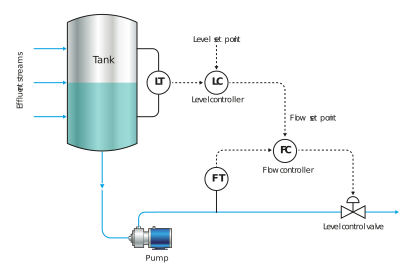
Figure: Cascade control for level control using flow control
The level on the tank is the primary loop. The output of the primary loop is a setpoint to the secondary loop, which is the flow control loop.
The advantage of this system is that it shields the secondary loop from huge oscillations. In a brewery, some dilution water plants (D-plants) are controlled in order to maintain a certain level within a tank. If this flowrate had to ramp up and down, the D-plant operation would be unstable.
Another example is lauter tun run-off. With a lauter tun, the aim is to have the differential pressure across the bed increase slowly so that it does not compact the bed. This can be controlled by lowering the flowrate. However, the flowrate needs to be maintained within a certain band, so the setpoint for the flowrate is controlled by the output of the differential pressure controller.
Ratio control
Ratio control uses the measurement of one variable to control the setpoint to a second variable. This is frequently used for the control of dosing or blending. In the brewery, this is used for dilution control. However, many modern blenders have alcohol measurement and use this to control the dilution. An example of this is shown below:
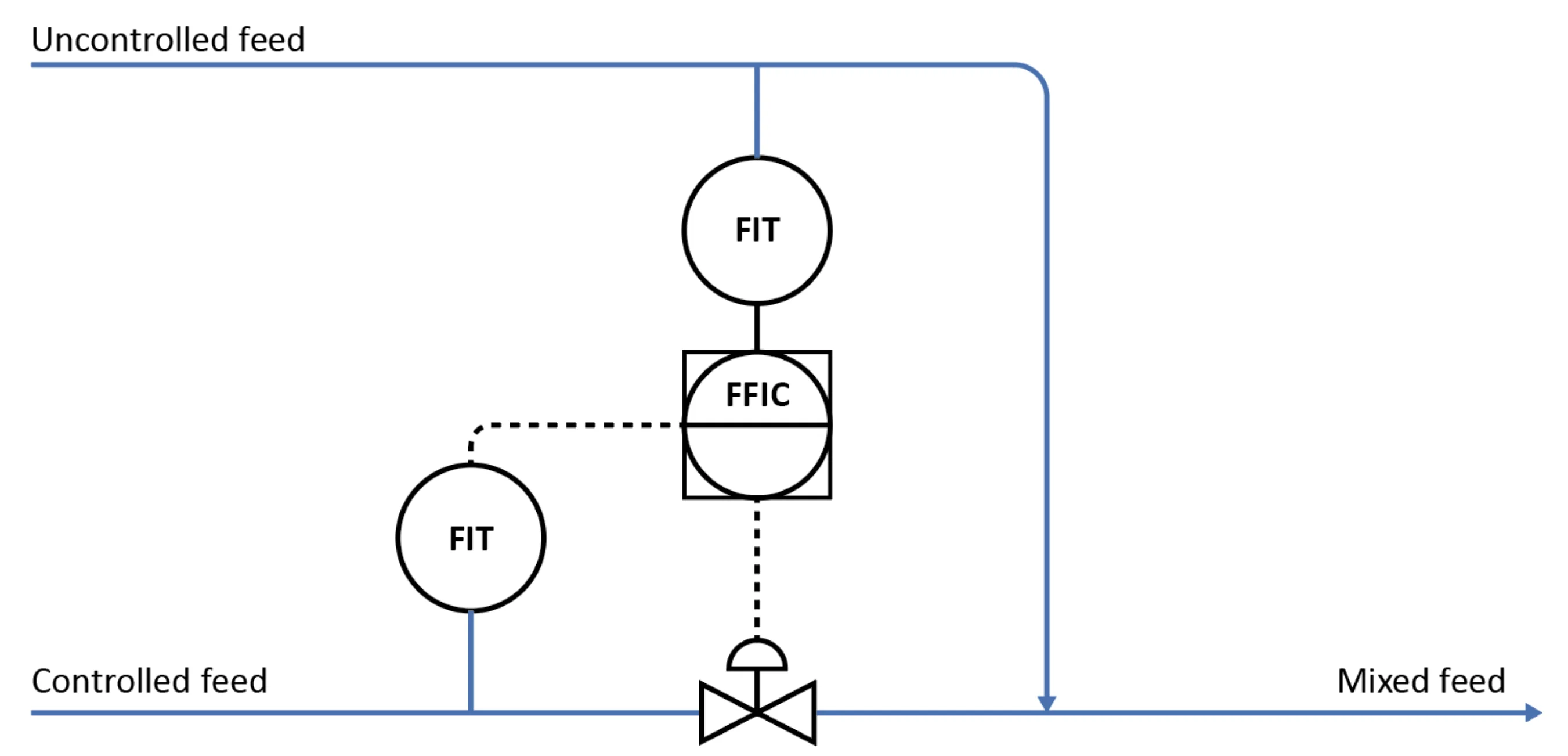
Figure: Ratio control
Here, both streams are measured and only one stream is controlled. Ratio control will always lag a little, but as there are normally inline buffers, the small variations are taken care of.
The final effect of ratio control also depends on the accuracy of the system. If you are measuring dilution, alcohol based on one sample taken from a beer vessel may not be representative of the entire contents of the vessel if there is layering in the tank.
Very modern blending systems can be used for mixing the final product inline. These systems measure and control every component. They also use accumulated flow totals to adjust the ratios and correct for any offsets.
Split controllers
Split controllers typically output to two devices. This is often done to achieve precise temperature control where heating or cooling may be required, or alternatively for pH control where we may need to add acid or caustic. The figure below gives an example of temperature control:
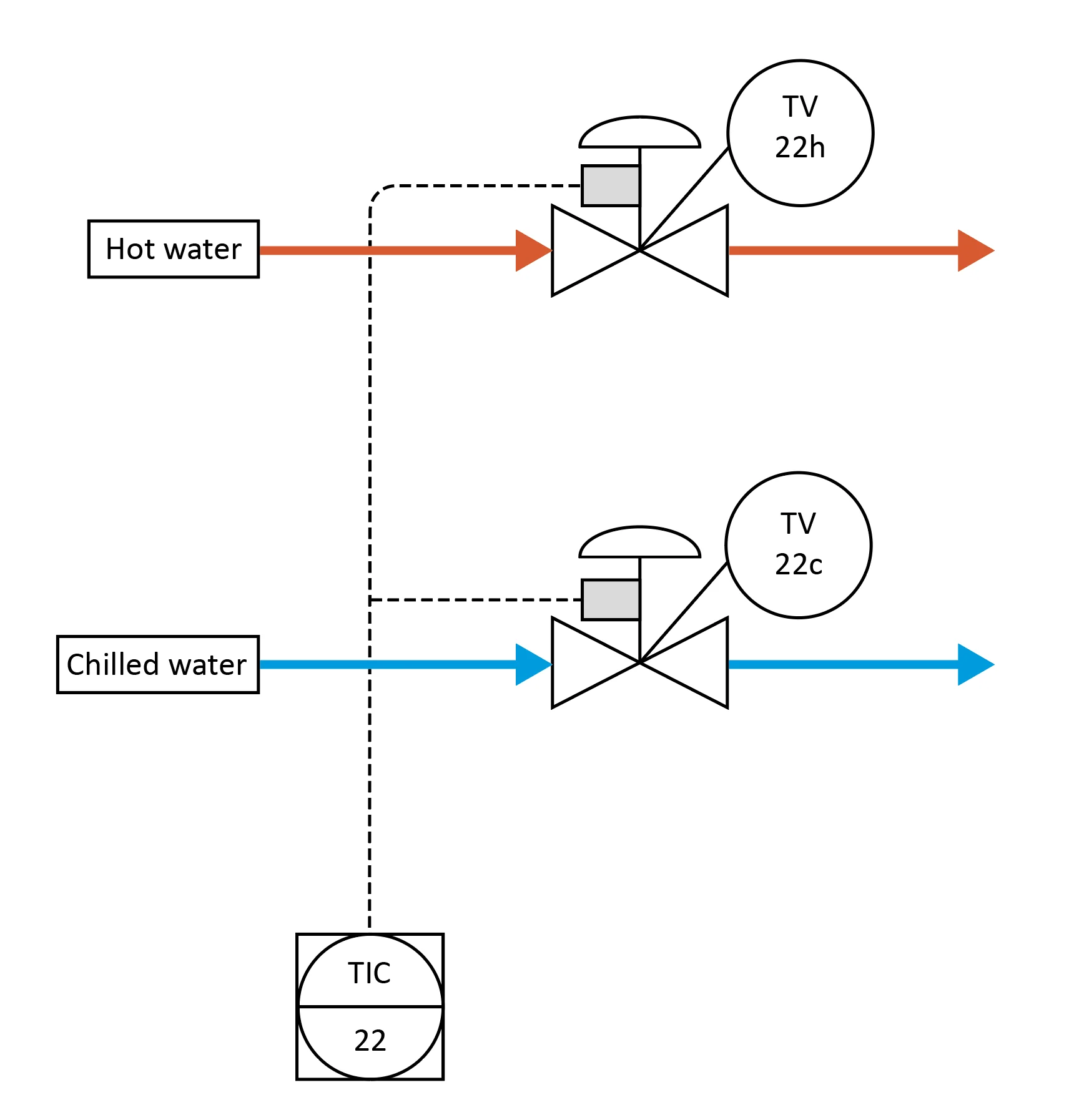
Figure: Split controller for water temperature control
The output signal is split over the two devices, but not necessarily at 50% output (as this will depend on the system’s design).
We must keep in mind that the switch over point can result in cycling and frequent switching between the two control elements.
Cascade control is where one control loop (being the primary control loop) outputs the setpoint for another control loop (being the secondary control loop).
Ratio control uses the measurement of one variable to control the setpoint to a second variable.
Split control splits the output signal over two devices.