
Lesson 6 - Process Control Mechanisms
This lesson looks more closely at the mechanisms of process control. It identifies and explores the different ways in which variables can be controlled, including the types of process control used for this. It also investigates how process controls work. and will briefly touch upon control configurations and sequence control.
Discrete Control
Many control loops lack sophisticated control elements and work solely on the basis of turning something on and off or changing them between open and closed. This is known as discrete control or on/off control.
Think of the previous example regarding clothes. If you had been a caveperson, you may have only had one deerskin to keep you warm. Thus, your only options would have been ‘on’ or ‘off’.
This would not have resulted in perfect control as your body temperature would have dropped without the deerskin and would have risen with it. This band of temperature fluctuation is referred to as the hysteresis of the controller.
On a nice day, that was neither too hot nor cold, this control strategy may have been problematic. You would have expended a lot of energy if you had needed to do this every five minutes as your temperature fluctuated between too hot and too cold.
One option would have been to allow your temperature to go up a bit higher and down a bit lower every time, and thus you would have only needed to change your clothing situation every 30 minutes. This would have saved you some energy, and also would have saved your precious coat from wear and tear. This is referred to as having a ‘deadband’. It is dead in that it allows the process variable to go above and below the setpoint without reacting.
On/off control works well in certain applications. Maintaining a level is an example of this. Typically, a tank will have two levels: a full level at which filling must stop and a level at which filling must start. See the figure below:
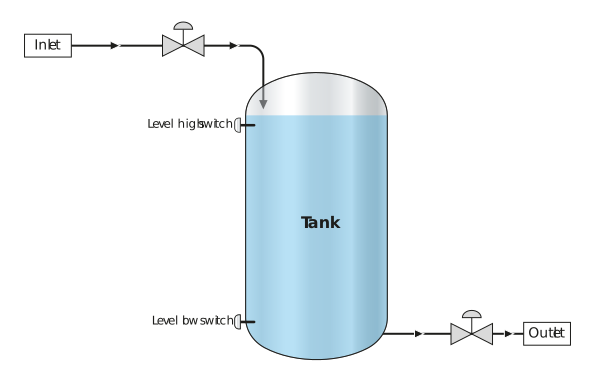
Figure: On/off control for a tank
In certain applications, temperature is also well suited to on/off control. Think of the thermostat in your oven or on your hot water geyser.
However, on/off controllers on fridges and freezers that run the refrigeration motors have a way of preventing the motor starting and stopping all the time. This can be in two forms. One form is a restart delay that prevents start-up within a certain time after it has stopped. The other form is a deadband range. The figure below shows the operation of a deadband:
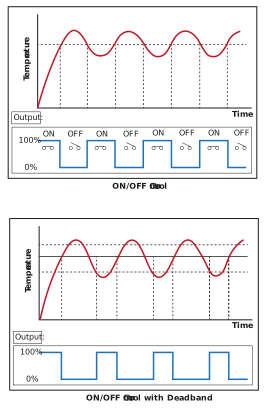
Figure: Basic on/off control without and with a deadband
As the figure above shows, a deadband turns the output on at a setpoint below the target and turns it off at a setpoint above the target. This results in the output being turned on less frequently than would be the case without the deadband.
Multistep controllers
Multistep controllers operate in a very similar way to discrete controllers, but they have more than one control function they can switch on or off, or can control at more than one rate. This may take the form of opening a second valve if a tank has reached a very low level or turning on a second heating element if the temperature is very cold.
Advantages and disadvantages of discrete control
Discrete control is a simple, effective way of controlling a process. However, it has two failings. Firstly, you can never be precisely at the setpoint required, and thus it is not suitable if we need a higher level of accuracy. Secondly, repeated switching increases the mechanical wear and tear on the control elements.