
Lesson 6 - Process Control Mechanisms
This lesson looks more closely at the mechanisms of process control. It identifies and explores the different ways in which variables can be controlled, including the types of process control used for this. It also investigates how process controls work. and will briefly touch upon control configurations and sequence control.
Point of Reflection – Reconvene
Welcome back. So, what were your thoughts?
Feedback control has the following advantages:
-
It counters all types of disturbances.
-
We do not need to know the precise nature of the disturbances.
However, it also comes with some disadvantages:
-
It requires a disturbance before it can react.
-
It does not take into account known disturbances.
-
It does not work well in processes with long time delays.
-
It requires the controlled variable to be measured.
Feedforward control has the following advantages:
-
It takes corrective action before the upset occurs.
-
Certain processes may not tolerate large errors, and feedforward control can potentially prevent these situations.
It also comes with some disadvantages:
-
We may not be logistically able to measure the disturbances.
-
It depends on the accuracy of the model and if any disturbances are unmeasurable, it becomes very difficult to control the process.
-
The process variable is not measured, which means it could drift over time.
Combined feedback and feedforward control
In certain situations, in order to have the best of both worlds, it is possible to combine feedback and feedforward in order to gain better control over our processes. The feedforward control therefore provides a fast, predictive reaction to disturbances whilst feedback control corrects for any long-term deviations that may occur. The figure below shows a system where feedforward and feedback control have been combined:
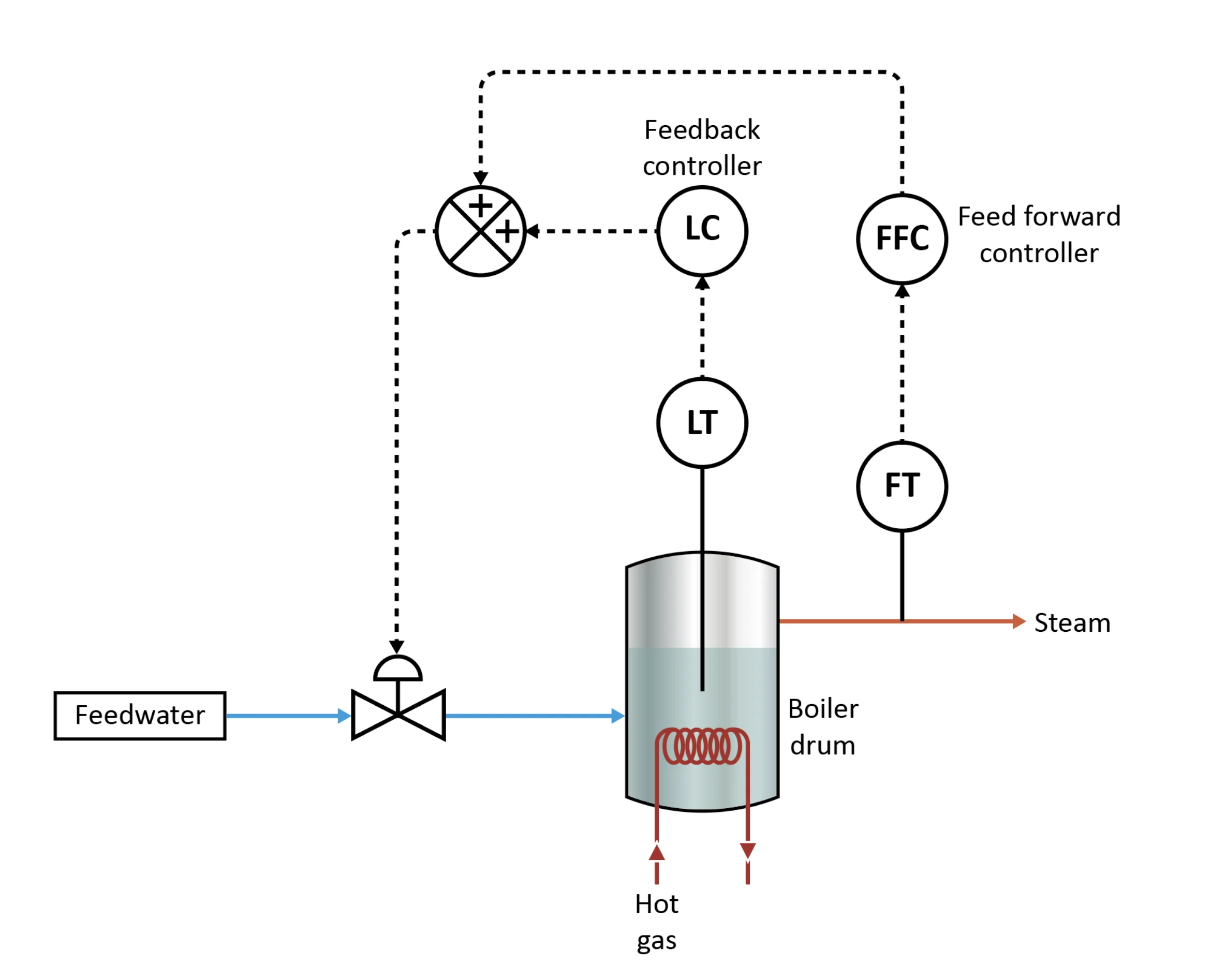
Figure: Combined feedforward and feedback control
In this instance, the bulk of the control is carried out via the feedforward control, which is measuring the disturbance of steam exiting the drum. If a situation arises where the level is not being maintained based on the feedforward control alone, the feedback control from the actual level will also feed into the controller.