
Lesson 6 - Process Control Mechanisms
This lesson looks more closely at the mechanisms of process control. It identifies and explores the different ways in which variables can be controlled, including the types of process control used for this. It also investigates how process controls work. and will briefly touch upon control configurations and sequence control.
Preface
The mechanisms of process control vary from very simple self-acting systems, to on/off control, to advanced process control loops and sequence control.
Process control forms part of our daily life. Even deciding how many layers of clothes to put on in the morning is a form of process control. In essence, we have something we want to control (how warm we feel), a strategy for how to control it (our thoughts on what to wear), and a way to effect the control (putting on more or taking off layers).
At its core, process control has three steps:
-
Measure the variable you wish to control
-
Decide how to control it
-
Act by changing an input into the system
These steps normally ‘loop’ in a continuous fashion; therefore we refer to them as process control loops.
Open and closed loops
A simple distinction would be between an open loop and a closed loop system. In the open loop example, you may check the weather forecast, decide five layers of jackets is called for, and end up wearing that for the rest of the day regardless of whether you were boiling or freezing. In the closed loop example, you will constantly check how warm you are and adjust your clothing as required.
A closed control loop is always measuring something and adjusting accordingly, whilst an open control loop acts without this measurement taking place.
Process control terminology
In order to really understand process control, we must have a basic understanding of its associated terminology:
The process variable (PV) is the variable in the process that you wish to control. In certain cases, you cannot measure this directly and you may have another variable, which is the measured variable.
The disturbance variable or load disturbances are the variables in the process that act on the process variable.
The setpoint value (SP) is the desired value for the process variable.
The control mechanism is the process or decision used to affect the change in the variable value.
The manipulated variable is the variable you can use to control the process variable. We also call it the controller output (CO).
The error (ε) is the difference between the process variable and the setpoint. For the purposes of this lesson we will define it as:

Some conventions do it the other way around, so you must make sure you know which one you are working with. The following figure shows all these components in a typical control loop:
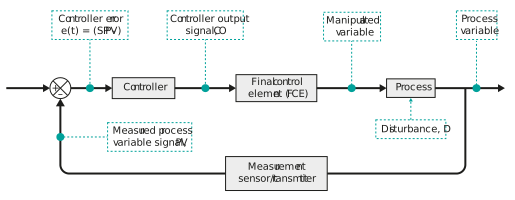
Figure: Components of a typical control loop