
Lesson 6 - Process Control Mechanisms
This lesson looks more closely at the mechanisms of process control. It identifies and explores the different ways in which variables can be controlled, including the types of process control used for this. It also investigates how process controls work. and will briefly touch upon control configurations and sequence control.
Proportional Control
Proportional control is where the change in the controller output is proportional to the error.
Using our shower example, this means that you will change the position of the tap (the controller) in proportion to how too hot or too cold the water is (the error).
Controller gain
Gain (Kc) is defined as the ratio of the percentage change in output signal to the percentage change in input signal. It can also be represented using different units, however for the purposes of this lesson we will stick to expressing the value as a percentage:

If your hot water range is 0-100°C, this is your output. If your tap is then 100% open, this is your input. If a 100% change in input results in a 100% change in output, then your gain will have a value of 1.
Another way of representing this is with proportional band (PB). Proportional band indicates the percentage change in input required to cause a 100% change in controller output:

Some controllers also have separate gain terms for proportional, integral, and derivative, however the principles remain the same.
The following figure shows examples of three different values of gain and how they relate to proportional band:
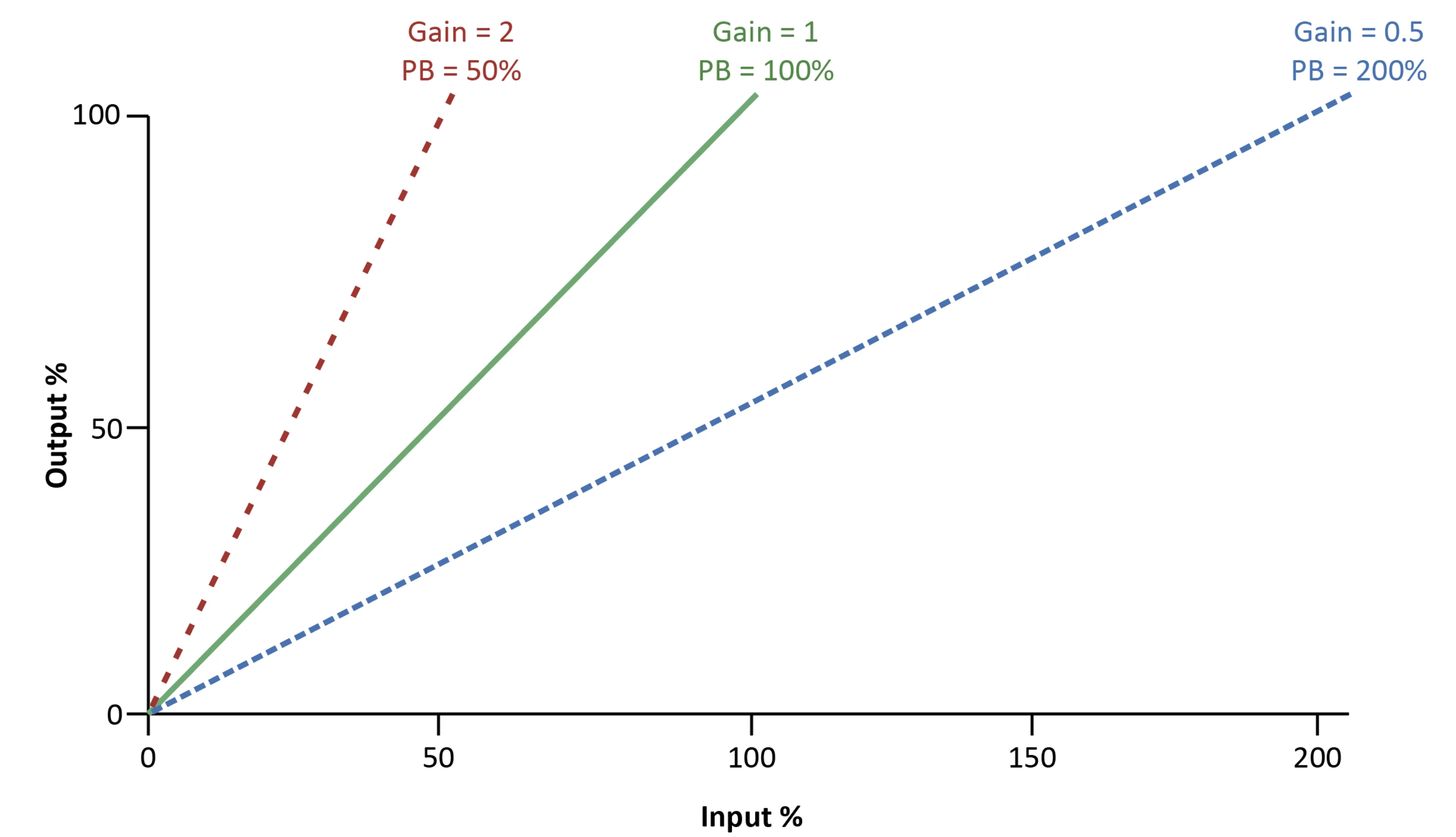
Figure: Gain and proportional band
Looking at the three gain lines above, you can see three scenarios from left to right.
-
The first line represents a fast gain. If you apply this to the shower example, you only have to turn the tap 50% to get a 100% change in output.
-
The second line represents a medium gain, so you need to turn the tap 100% to get a 100% change in output.
-
The third line shows a slow gain; you would have to turn the tap 200% to get a 100% change in output.
So why do we need different gains? The answer is that the process reaction can be fast or slow. Imagine filling a bath full of cool water from a tap. If you are controlling the temperature, you would want a fast gain in this case, so that the tap opens fully to correct the temperature within a short time. If, however, you are standing under a shower, the change in the temperature can be instantaneous. In this instance, you would want a small gain.
Controller algorithm
So, how does this work in practice? What output is sent to the controller? The following equation illustrates how this works:

Where:
COP(t) = the output of a controller at time t
ε(t) = the error from the controller (PV – SP) at time t
B = the bias value of the controller
Bias is the value that a controller outputs when the process variable and the setpoint are equal. If there was no bias term, the controller would shut down every time you reached the setpoint!
We now need to understand offset. Offset is the steady state error that occurs when the controller value settles out. This is because the proportional controller is set up for a very specific condition. Offset occurs because as the error term decreases, the influence of the proportional gain decreases, and the value can then thus fall short. Let us consider the following figure:
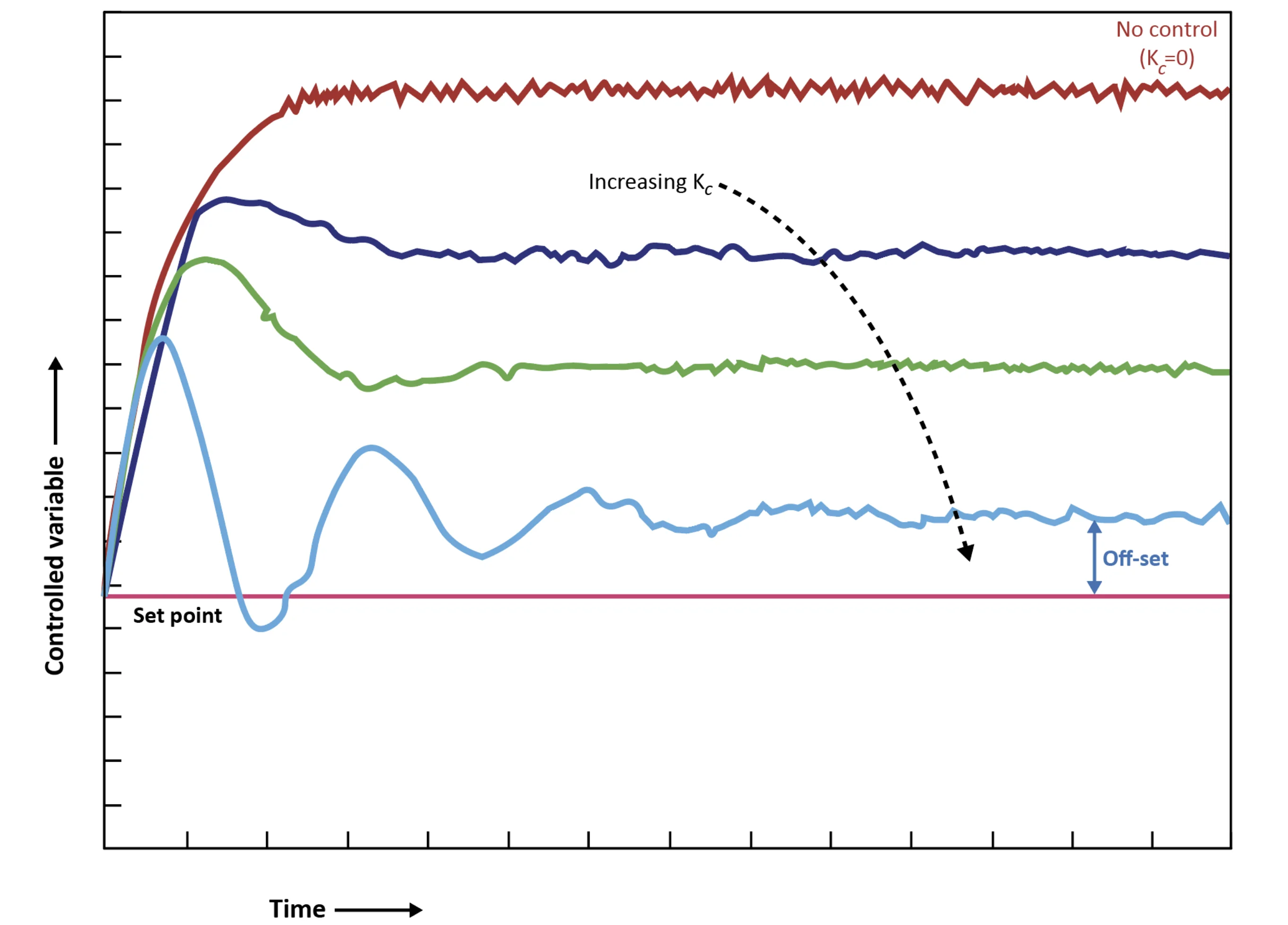
Figure: The effect of gain on proportional controller action and offset
An increasing gain results in more oscillation and the potential to overshoot, but it also reduces offset.
In practice, this offset would remain until the controller was reset. An automatic controller that requires operator input would be similar to having your television (TV) remote control bolted to the wall under your wall mounted TV.
Which brings us to integral controller action. The function of the integral controller is to automatically compensate for the offset and correct it.