
Lesson 6 - Process Control Mechanisms
This lesson looks more closely at the mechanisms of process control. It identifies and explores the different ways in which variables can be controlled, including the types of process control used for this. It also investigates how process controls work. and will briefly touch upon control configurations and sequence control.
Self-acting Control Mechanisms
Many controllers are designed to work on their own. The key to distinguishing them from other controllers is that their action is manual and does not rely on any decision being made.
Level control is often self-acting, and this action is normally carried out through a float valve. As the level rises, a float is pushed up. The float is attached to a valve and the valve is forced closed by the float mechanism. The figure below shows an example of this:
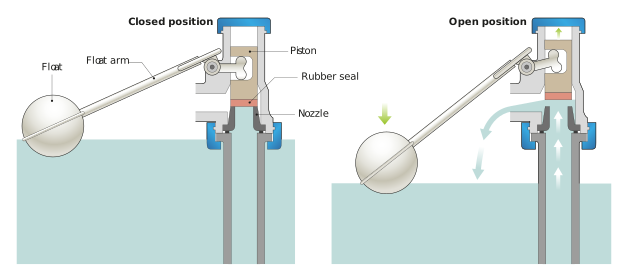
Figure: Float valve level control
These can often be found in level control for water tanks in smaller breweries.
Another example of a self-acting mechanism is a manual pressure regulator. Here, we control the downstream pressure. The figure below shows that the downstream pressure impacts the diaphragm. As the pressure increases, the diaphragm is pushed up and the valve closes more.
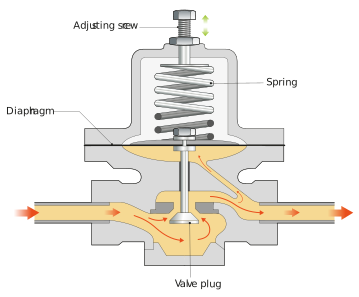
Figure: Self-acting pressure control valve
Self-acting control may be basic, but using self-acting pressure control valves does bring some advantages:
-
They are typically robust, reliable and inexpensive compared to automated controls.
-
They do not rely on power or control systems for actuation. This makes them well suited for applications where safety is a concern. Vacuum breakers and pressure relief valves on fermenters are examples of self-acting controllers that protect your vessels.
They do, however, have the disadvantage that they are not as accurate, and it is difficult to set them up at the exact setpoint you require. There is also no feedback inherent in them if they fail. However, we can overcome this by measuring the variable they have to control and alarming it or by installing some form of switch to detect whether they have failed.