
Lesson 6 - Process Control Mechanisms
This lesson looks more closely at the mechanisms of process control. It identifies and explores the different ways in which variables can be controlled, including the types of process control used for this. It also investigates how process controls work. and will briefly touch upon control configurations and sequence control.
Integral Control
Integral control exists to eliminate the steady state offset.
So how does integral control work? It keeps track of the cumulative error term over a period and uses this to compensate for the offset. It is essentially the memory of the controller.
The equation for the integral controller is as follows:

Where:
COI(t) = the controller output for the integral term
Kc = the controller gain
TI = the integral time constant
It is sometimes called the “integral gain”:

 is the sum of the error term over time. (Integrals are the sum of the values of a term over time from 0 to t.)
The figure below shows how the error term is continuously calculated:
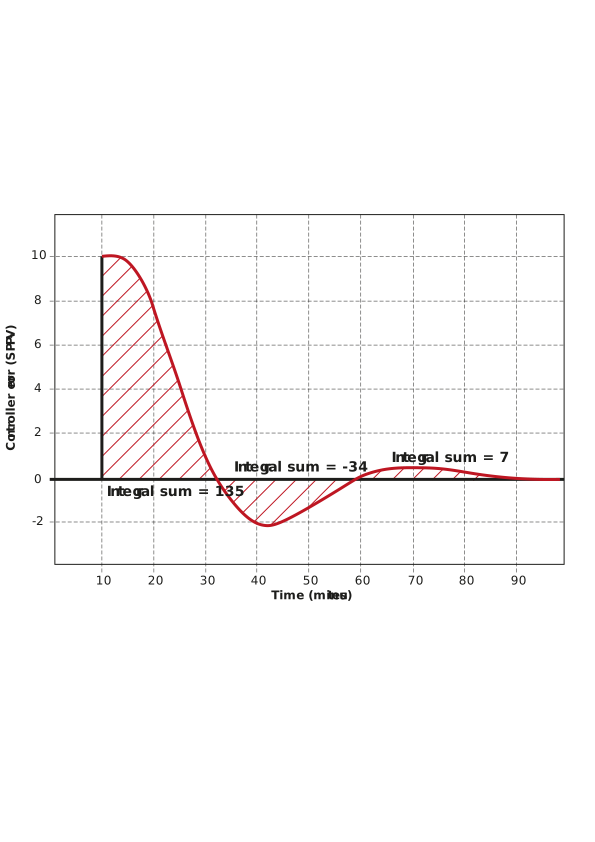
Figure: Integral error term
In order to control the impact of the integral term, we can adjust TI. Thus, by making TI smaller, the impact of the integral term will be larger. The figure below shows this in action:
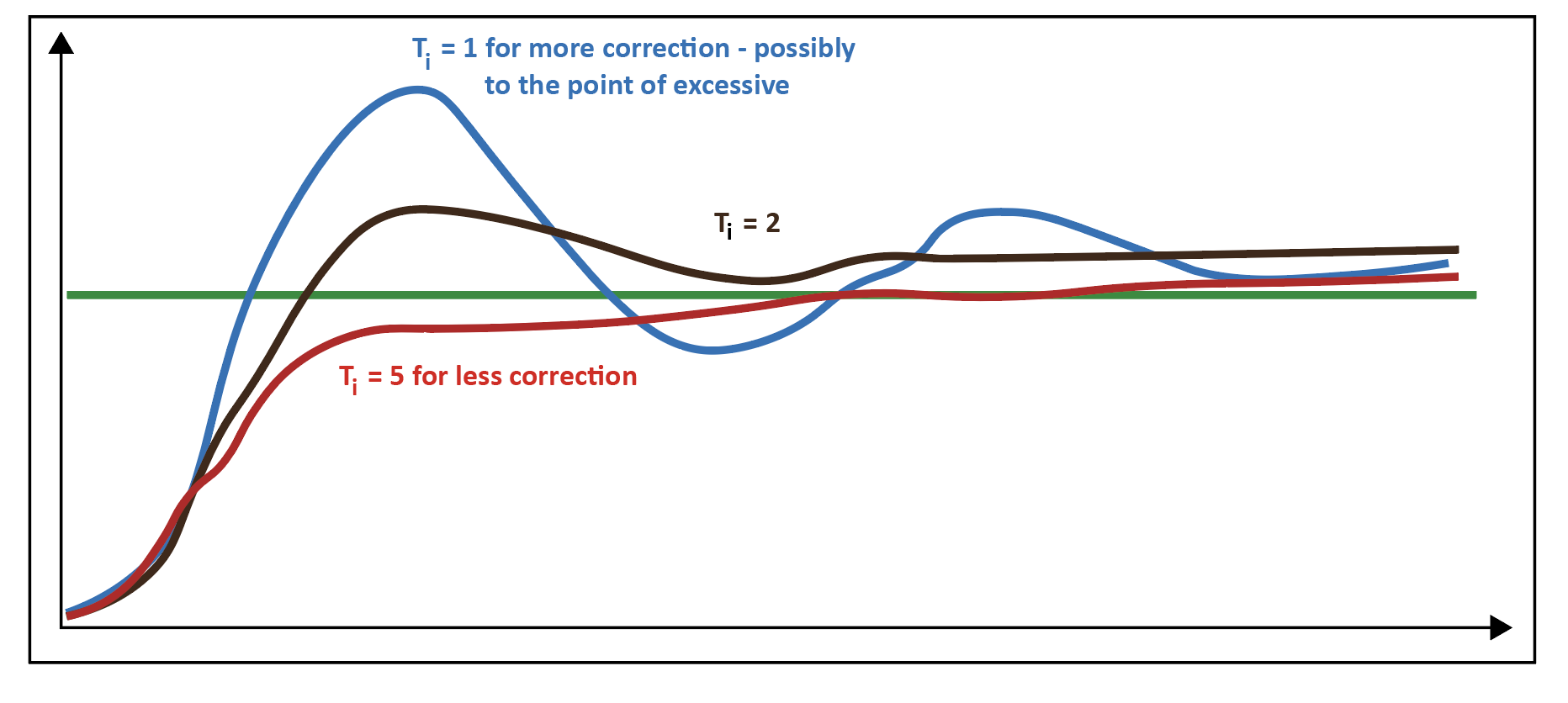
Figure: How the integral time constant influences loop behaviour
For the blue line in the figure above, the integral term was amplified, which resulted in an overshoot. We could liken this to being in the shower and feeling ten seconds of cold water, and then overreacting by opening the tap up fully, only to be scalded. For the red line, the integral term was very small. This is similar to standing under the cold shower for two minutes before you acknowledge that it is cold.
Integral controllers do not operate on their own. Let us quickly look at what happens if you combine proportional and integral control.