
Lesson 6 - Process Control Mechanisms
This lesson looks more closely at the mechanisms of process control. It identifies and explores the different ways in which variables can be controlled, including the types of process control used for this. It also investigates how process controls work. and will briefly touch upon control configurations and sequence control.
Single Loop Control Configurations
Whilst control loop algorithms determine the characteristics of each loop, the way in which these loops are arranged plays just as important a role.
Let us have a look at the two possible configurations: feedforward and feedback control.
Feedforward and feedback control
These are the two most common forms of control. So how do they differ?
With feedback control, the process variable you are trying to control is measured directly and this value is then used to control the process.
With feedforward control, the main disturbance on the process is measured and then used to control the process. Feedforward control is a type of open loop control system. The figure below shows this for two applications:
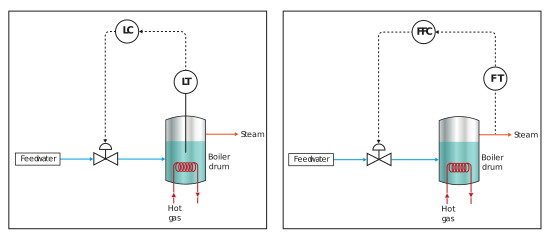
Figure: Typical feedback and feedforward control loops
In the first diagram, the level transmitter is sending information back to the control valve. We are using the level in the drum to adjust the control of the inflow. Here, we are using the actual value that has been directly measured. Something has happened, and now we adjust accordingly.
In the second diagram, we are using the flow out of the drum to adjust the control on the inflow. In this case, we are predicting the effect on the level. We are looking forward to what we expect to happen with the level.
What are the advantages and disadvantages of feedforward vs feedback control? Give yourself 5-10 minutes to think about this, and then click ‘Next’ to continue with this lesson.