
Lesson 6 - Process Control Mechanisms
This lesson looks more closely at the mechanisms of process control. It identifies and explores the different ways in which variables can be controlled, including the types of process control used for this. It also investigates how process controls work. and will briefly touch upon control configurations and sequence control.
Point of Reflection – Reconvene
Welcome Back. So, what were your thoughts?
The complete PID controller equation is as follows:

The following graph shows how the three actions can typically look if they are well tuned:
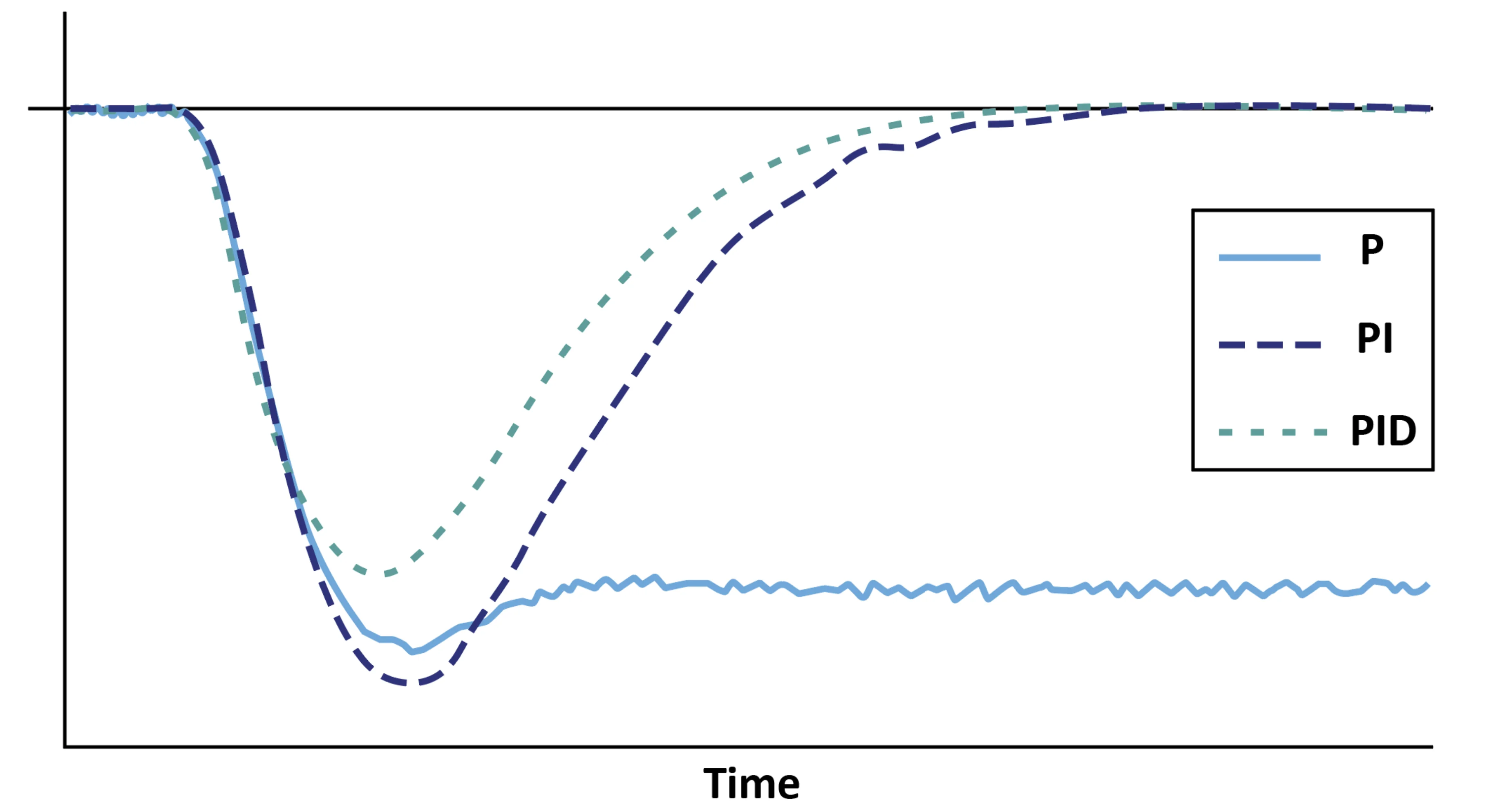 Figure: The result of a P, PI, and PID controllers’ response to a disturbance
Thus, proportional control (the P curve) on its own leaves us with an offset. Adding integral control (the PI curve) removes the offset but can result in an overshoot. Adding all three terms together (the PID curve) can give us faster control without offsets or overshoot.
However, the truth is that the answer depends on the process and how well each loop is tuned; this may mean leaving out derivative control, and perhaps also integral control.
Controller term selection
The following three guidelines will help us with our selection:
-
If an offset can be tolerated, P only will work. This could be a tank level that is not critical to the process.
-
If an offset cannot be tolerated, use PI control. This could be for temperature control within the process.
-
If the process is very sluggish and you are not concerned about a noisy measurement, use PID.
The table below shows the combinations used for the most common process control loops:
Table: Control loops and control algorithms
|
Controlled Variable |
Type |
Proportional Control |
Integral Control |
Derivative Control |
|
Flow |
Fast |
Low |
High |
No |
|
Level |
Integrated |
High |
Low |
Must Have |
|
Temperature |
Slow |
High |
Low |
Low |
|
Pressure |
Fast |
Low |
High |
No |
Loop tuning
We can conduct loop tuning by following a number of methods. Many controllers involve complex methods whilst some come with tuning software, and even autotuning. The important thing to consider is whether the loop tuning will work under all conditions. Typically, start-up can be very complicated for a controller. Many controllers thus offer options such as hold values and times for start-up, which can then quickly move the controlled variable into the right range before the controller takes over.
The theory of the three term, or PID, controller was developed by Nicolas Minorsky whilst he was designing automatic ship steering. He noted that the helmsman adjusted his steering based on the current course error, how long the ship had been off-course, and what the current rate of change in the course was.