
Lesson 6 - Process Control Mechanisms
This lesson looks more closely at the mechanisms of process control. It identifies and explores the different ways in which variables can be controlled, including the types of process control used for this. It also investigates how process controls work. and will briefly touch upon control configurations and sequence control.
Derivative Control
Derivative control takes into account the rate of change in the process variable, and the direction of the change.
Derivative control is used in processes that react very slowly to changes in controller output. It is concerned with the rate of change in the error.
Derivative control uses the current rate of change of the error to extrapolate what the future error will be.
Let us consider the equation for derivative control, which is as follows:

Where:
COD(t) = the controller output for the derivative term
TD = the derivative time (in minutes)
(It is also sometimes stated as derivative gain):

 = the rate of change of the error term (stated as a maths derivative term)
The longer the derivative time, the more gain that will be added to the controller based on the rate of change in the error. The figure below shows the effect of increasing derivative time or derivative gain:
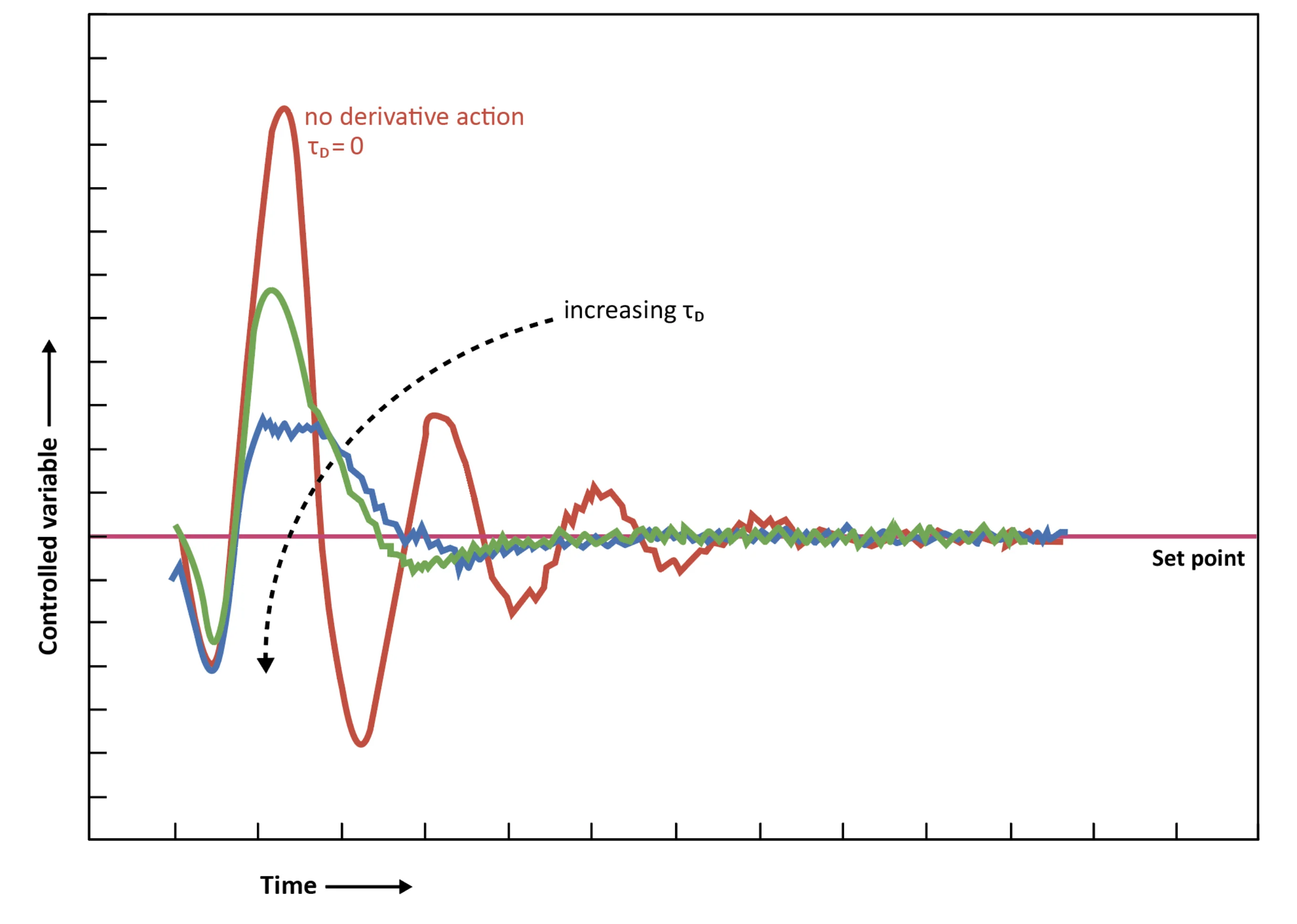
Figure: Effect of derivative time on controller action
As you can see, derivative action can decrease the overshoot. It does, however, result in a more noisy output, meaning that the controlled variable is not as smooth. In the case of fast-acting controllers, this can result in a process with a lot of variability. Flow control is a good example of this. A fast-flowing fluid in a pipe can give you a large range. As the flow will often be turbulent, the measurement thereof will be variable.
Measurements that are also noisy will in turn make derivative control even more noisy. An example of this is shown in the figure below:
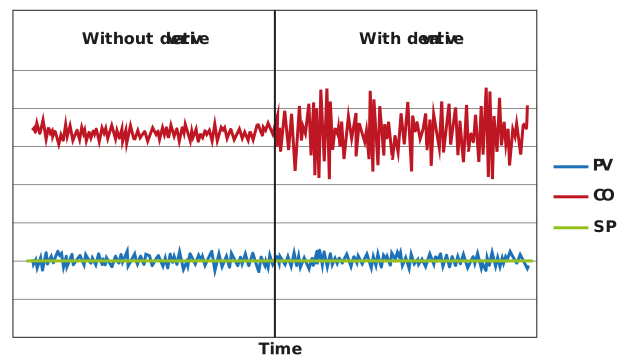
Figure: Effect of noise on derivative
This figure clearly shows that derivative control is not appropriate for this particular situation. In fact, it would be a little like pouring oil on a fire.