
Lesson 8 - Heat Exchangers
This lesson focuses on the two main heat exchangers found in breweries, namely plate heat exchangers and shell and tube heat exchangers. The lesson will examine the components, assembly, and operation of these exchangers. It will also discuss how to select and size a heat exchanger and the considerations for cleaning, maintaining, and operating heat exchangers in the brewing process.
Cleaning Heat Exchangers
You will have realised by now that despite all the measures taken in the design and sizing of brewery heat exchangers they will foul, build up scale, and/or block. This lowers the performance of the heat exchanger so it must be cleaned for the performance to return to design. Below, we examine different considerations for the cleaning of brewing heat exchangers.
The figures below illustrate the difference between a fouled and clean heat transfer surfaces.
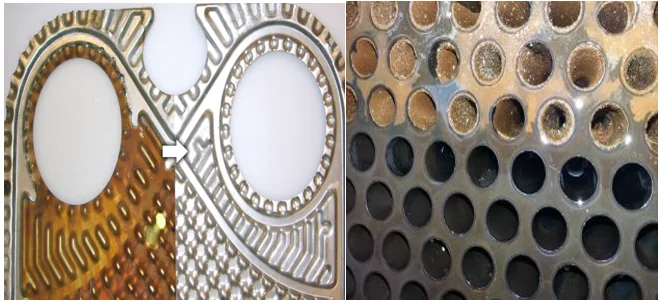
Figure: Fouled and clean plate of a plate heat exchanger (left) and fouled and clean tubes of a shell and tube exchanger (right)
A 0.6 mm thick layer of fouling or scale reduces the heat transfer rate by 20%.
The purpose of cleaning is:
-
To remove organic fouling
-
To remove inorganic scale
-
To remove blockages
Below are five considerations for heat exchanger cleaning that will ensure exchanger performance is maintained.
-
Cleaning frequency – with wort and beer, organic loading is high, so the product side of the exchanger must be regularly cleaned. CIPs are performed with the cleaning solution flowing in the reverse direction to product flow. This prevents the cleaning process driving any organic material further into the heat exchanger. The frequency of cleaning is determined by the product characteristics and the operating temperature. Heat exchangers used in the brewhouse, for example, where the product fluid is wort at high temperature with a high particulate matter, require more frequent cleaning.
-
Cleaning flowrate – to ensure effective cleaning, there needs to be turbulent flow. The plates of plate heat exchangers and the tubes of shell and tube exchangers are specifically designed for high velocities (to achieve maximum heat transfer). These characteristics also work during CIP. To ensure effective cleaning is achieved, CIP flowrates should be 1-1.5 times the normal operation flowrate.
-
Preventing solids – where small particulate matter (e.g. trub in wort) can be carried over into the exchanger, CIPs are performed in the reverse direction to the normal process flow. Furthermore, strainers can be installed on the upstream side to stop material carryover. These strainers need to be removed and cleaned regularly.
-
Cleaning effectiveness – after the CIP has been completed, the product and utility fluid flowrates and outlet temperatures should be monitored. If the cleaning has been effective, these parameters returned to their original design conditions. If they do not, the CIP was not effective and should be repeated.
-
Deep cleaning – if a heat exchanger is badly fouled or blocked, inline cleaning alone may not be effective. The exchanger will need to be opened and cleaned manually, as shown in the image below. This can be a time-consuming exercise during which the exchanger will be out of service.
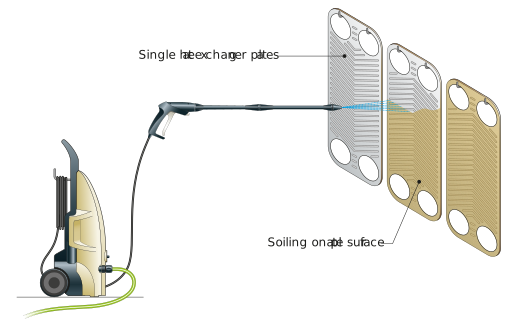
Figure: Deep cleaning of heat exchanger plates with a high-pressure hose
Opening up a heat exchanger has the following further negatives:
-
There is an inherent risk that when the heat exchanger is reassembled, the gaskets do not seal, and the heat exchanger leaks. The risk of this is far higher in plate heat exchangers than shell and tube.
-
Most suppliers recommend that when an exchanger is opened a new set of gaskets should be installed before closing it up, which adds operational costs. In plate heat exchangers these costs can be considerable.
So far, we have referred to the cleaning of the exchanger’s product side. It is also possible for scale to build upon the utility side. One of the main advantages of plate heat exchangers is that the utility fluid side is easily cleanable when the exchanger is opened. With a shell and tube exchanger, it is considerably harder to clean the outside of the tube bundle. Design considerations like removable tube bundles can be incorporated if the utility fluid is prone to scaling.
Keeping the heat transfer surface of the exchanger clean is important in ensuring the exchanger stays efficient, but exchanger maintenance is also important to ensure that the exchanger remains reliable. We will look at this in more detail in the next section.