
Lesson 8 - Heat Exchangers
This lesson focuses on the two main heat exchangers found in breweries, namely plate heat exchangers and shell and tube heat exchangers. The lesson will examine the components, assembly, and operation of these exchangers. It will also discuss how to select and size a heat exchanger and the considerations for cleaning, maintaining, and operating heat exchangers in the brewing process.
Shell and Tube Heat Exchanger – Components and Assembly
Knowing the features of a shell and tube exchanger is important if we are to understand how it operates in a brewery. In this section, we will review the components and assembly of the shell and tube heat exchanger.
Exchanger components
As we can see in the image below, the shell and tube exchangers are constructed of a single tube or group of parallel tubes, called a tube bundle, enclosed within a metal tubular vessel called a shell.
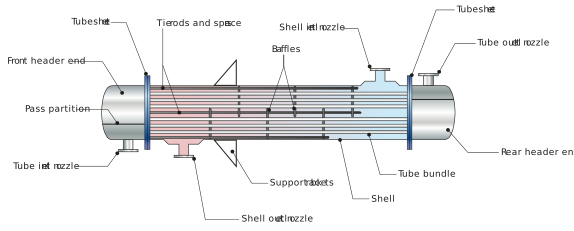
Figure: The components of a shell and tube heat exchanger
We will explore the design features of the tube bundle in more detail later. For now, let’s have a look at the other components of the shell and tube heat exchanger in the diagram above.
-
The exchanger in the figure above shows the most commonly used shell type, single-pass, suitable for most duties and applications. The internal diameter of the shell should be designed to provide a close fit with the tube bundle to maximise the flow of fluid over the tube bundles.
The shell of an exchanger is a pressure vessel and will be designed under the appropriate national pressure vessel code.
-
The inlet and outlet nozzles are where the product and utility fluid enter and leave the heat exchanger.
-
The front and rear header ends are fitted to either end of the shell. Typically, the ends are attached using nuts and bolts so the heat exchanger can be opened for maintenance and cleaning.
-
At either end, the tubes of the tube bundle are attached to a tubesheet. Its purpose is to hold the tubes in position and serve as the barrier that keeps the shell-side fluid inside the shell. The image below shows a close-up of a tubesheet attached to the end of a tube bundle.
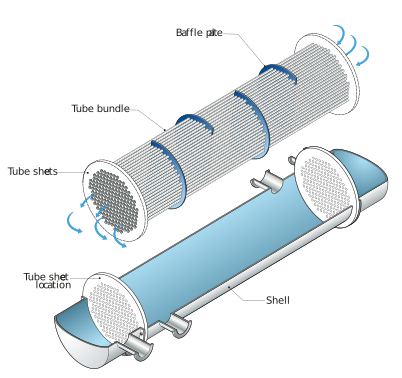
Figure: Tubesheet of a shell and tube heat exchanger
-
Baffles are sheets of metal positioned along the length of the tube bundle inside the shell. The baffles have holes cut into them that are the size and position of the tubes so that it fits exactly around the tube bundle. Baffles can be positioned in either the transverse or longitudinal position. Baffles have multiple functions:
-
To support the tube bundle, thus reducing damage due to vibration
-
To increase the turbulence of the shell-side fluid
-
To ensure there are no dead flow zones or areas where excessive scale can build up
-
Separate multiple pass streams of the shell-side fluid
-
The segmental baffle in the figure below is the most common baffle configuration found in brewing applications. The baffle forces an up/down flow pattern across the length of the exchanger. Compared with other configurations, this design imparts the greatest turbulence but also has the highest pressure drop.
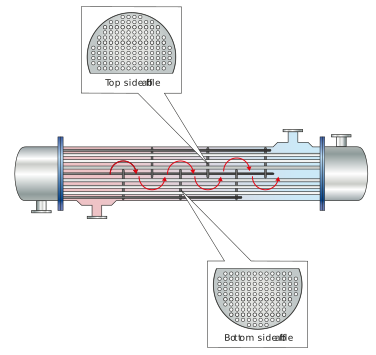
Figure: Segmental baffle configuration
-
Tie rods and spacers are used to hold the tube bundle together, and the shell baffles in position.
-
Pass partitions, or baffles, can be found in the front and/or rear header ends. They are used to separate the multiple pass streams of the tube-side fluid.
-
Turbulators can be located inside the tubes. Their purpose is to create a turbulent flow to increase heat transfer rate and also keep the inside of the tubes clean.
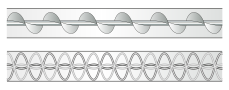
Figure: Different types of turbulators used for shell and tube heat exchanger
Watch the video below to see how shell and tube heat exchangers are assembled.
Materials of construction
In food and beverage applications, the tubes of shell and tube exchangers are made from stainless steel which allows for good heat transfer, and they can easily be cleaned in place. The shell is typically made from carbon steel as it is cost-effective and compatible with most utility fluids. Shells can be manufactured in stainless steel, but this very costly.
The American Tubular Exchanger Manufacturers Association (TEMA) publishes standards defining all aspects of shell and tube exchangers design and assembly. British standards BS3274 also cover the design, fabrication, material, and testing standards of shell and tube heat exchangers.
You now have a good understanding of the main components of the shell and tube heat exchanger. In the next section, we will see how these components are configured in three types of shell and tube exchangers.