
Lesson 8 - Heat Exchangers
This lesson focuses on the two main heat exchangers found in breweries, namely plate heat exchangers and shell and tube heat exchangers. The lesson will examine the components, assembly, and operation of these exchangers. It will also discuss how to select and size a heat exchanger and the considerations for cleaning, maintaining, and operating heat exchangers in the brewing process.
Point of Reflection – Reconvene
Welcome back. So, what were your thoughts?
Did you notice that the plates are a very thin solid sheet with no joins? Maybe you also saw that the plates are embossed rather than smooth?
Because the plates are where heat transfer occurs, designers of plate heat exchangers are constantly trying to achieve three key outputs:
-
Maximise the heat transfer area.
-
Maximise overall heat transfer coefficient by enhancing turbulent flow and minimising heat transfer resistance.
-
Ensure mechanical integrity by optimisation of the embossed configuration.
Below, we explain the general features you can expect to find on heat exchanger plates that best achieve a balance among these three requirements:
-
Plates are made from stainless steel which is strong and resistant to the cleaning detergents and temperatures used in brewing.
-
The plate material has a very smooth surface.
-
Plates are pressed from a single sheet of metal, so there is no point of weakness.
-
Plates are thin enough, typically 0.6 mm, to keep conductive resistance to a minimum (despite the relatively poor thermal conductivity of stainless steel), yet thick enough to withstand ‘normal’ operating pressures.
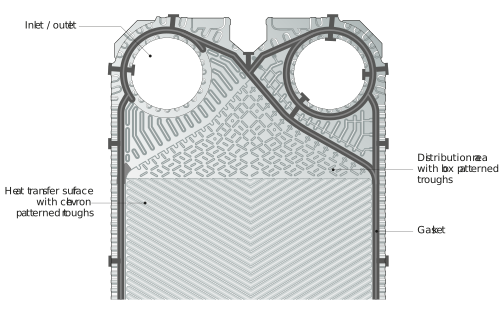
Figure: Various trough patterns embossed on heat exchanger plate
-
In the figure above, you will see that the plates have troughs of different shapes and patterns embossed into them. These enhance turbulent flow and ensure fluid is distributed evenly over the plate, so there are no dead zones. This can be seen in the following video clip. Note, this is for illustrative purposes only and is not a recommendation or endorsement of the supplier’s product.
Along with the embossed trough patterns on the plates, how the plates are assembled also enhances the turbulent flow further.
-
First, plates are spaced 1.3-1.5 mm apart, which creates a very narrow flow channel.
-
Second, alternating plates can be turned 180° to each other so that when placed together in the plate pack, their chevron patterns are opposite to each other.
Previously in this lesson, we discussed the downside of good turbulence to be higher pressure drop. All these features that provide such good turbulent flow in plate heat exchangers also result in them having high-pressure drops. A well-designed heat exchanger finds the optimum balance between these two outputs.
There are only a few plate manufacturers across the world, and each invests significantly in the research and development of their plates. A manufacturer’s plate design and its associated heat transfer performance is one of its competitive advantages and is not generally available in literature.
While the plates of a plate heat exchanger are key to the design, the exchanger would not operate without another key component, the gaskets. We will learn more about these in the next section.