
Lesson 8 - Heat Exchangers
This lesson focuses on the two main heat exchangers found in breweries, namely plate heat exchangers and shell and tube heat exchangers. The lesson will examine the components, assembly, and operation of these exchangers. It will also discuss how to select and size a heat exchanger and the considerations for cleaning, maintaining, and operating heat exchangers in the brewing process.
Point of Reflection – Reconvene
Welcome back. So, what were your thoughts?
Well, the first way to increase the surface area would be to have longer straws. Also, the more straws you can fit in your fist, the greater the total straw surface area would be. How could this be done? You can fit more straws by making the straws thinner or packing them closer together.
Maximising surface area is the first consideration in tube bundle design, but it is not the only one. It is also important to maximise the overall heat transfer coefficient by enhancing the turbulent flow and minimising heat transfer resistance. Ensuring mechanical integrity is the third and equally important consideration in tube bundle design.
Below are some features of a tube bundle that best achieves a balance between these requirements:
-
The tube walls should be thin. The wall thickness of stainless steel tubes ranges from 1.6-2.6 mm.
-
The diameter of the tubes should be small. As with a fist full of straws, this gives a high surface area to volume ratio and good turbulent flow. However, narrower tubes have a higher pressure drop and are harder to clean. Common tube diameters are 19 mm and 25.4 mm.
-
The tubes should be long. As with the straw exercise you considered above, the longer the tubes, the greater the heat transfer surface area. The optimum tube length to shell diameter ratio is in the range of 5-10:1.
-
The tube pitch (the distance between tube centres) should be small. The smaller the tube pitch (e.g. the more tightly packed the straws), the greater the total surface area. However, smaller tube pitches:
-
Weaken the tubesheet making it prone to cracking
-
Increase the shell side pressure drop
-
Increase the risk of shell side blockages and makes effective cleaning of the outside of the tubes difficult
-
A typical tube pitch is 1.25 times the tube diameter.
When you pictured the straws in your fist, were they neatly aligned in rows or haphazardly positioned?
To maximise the space available, tubes in a tube bundle are positioned in a specific geometric arrangement. Triangular tube arrangements, like in the image below, are the most suited to brewing heat exchangers.
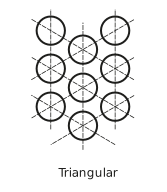
Figure: Triangular tube arrangements
Assembly of tube bundle and tubesheet
The tubesheet forms a barrier between the shell and tube fluids. The slightest flaw will become a point of weakness that can cause metal fatigue or corrosion. This can lead to pinhole leaks at the join point or cracking along the tubes through which the product contamination can occur.
Assembly of the tube bundle and tubesheet must be done by a skilled technician in accordance with the strictest quality standards and controls.
Now that we know about the key features of the shell and tube heat exchanger and how it is constructed, we can take a look at how it operates.