
Lesson 8 - Heat Exchangers
This lesson focuses on the two main heat exchangers found in breweries, namely plate heat exchangers and shell and tube heat exchangers. The lesson will examine the components, assembly, and operation of these exchangers. It will also discuss how to select and size a heat exchanger and the considerations for cleaning, maintaining, and operating heat exchangers in the brewing process.
Eliminating Risk of Product Contamination
One of the greatest concerns with plate heat exchangers is product contamination, e.g. utility fluid leaking into the product stream. In this section, we will learn about measures that can be taken in the design of the exchanger to minimise this risk.
The most likely source of contamination is a damaged or misfitted gasket. Leakage across the very thin plates is a second, potential source of contamination.
In addition to using the correct gasket, several measures can be taken in the design of the exchanger to minimise the product fluid contamination risk:
-
A pressure differential when applied across the area of the plate can create a considerable differential force. This can cause the plates to bend which will lead to leakage or damage. In plate heat exchanger design there are two ways a large pressure differential can be avoided:
-
Ensure supply pressures of the product and utility streams are within 20% of each other.
-
Ensure the product and utilities flowrates are kept within 15% of each other. This can be done by adjusting the utility fluid inlet and/or outlet temperature/s.
-
If neither of these is possible the heat exchanger plates will have to be made thicker to withstand a larger pressure differential.
-
If possible, and without compromising the first point above, the pressure of the product fluid is kept slightly higher than the pressure of the utility fluid. This way, if there is a leak, the utility fluid will be contaminated and not the product fluid.
-
Where the distribution passage is blocked to the flow channel, there are two gaskets; one around the distribution passage and one across the flow channel. The figure below shows how this creates a space which serves as a leakage chamber.
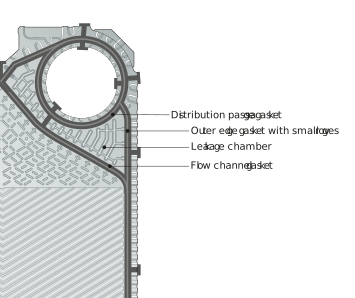
Figure: View of the distribution passage and flow channel gaskets and the leakage chamber between them
The video clip below shows how fluid in the leakage chamber is vented to atmosphere by the small grooves in the outer edge gasket. This serves as an indicator that a gasket is leaking and should be replaced. Note, this is for illustrative purposes only and is not a recommendation or endorsement of the supplier’s product.
-
Where contamination would have a severe impact on product quality or safety, double-walled plates can be used. Double-walled plates, as the name suggests, have two walls with a leakage chamber between. If one wall should fail, the liquid will pass into the leakage chamber and exit to atmosphere rather than contaminate the fluid on the other side of the plate. The double-wall plate lowers the heat transfer rate and also makes these exchangers very costly.
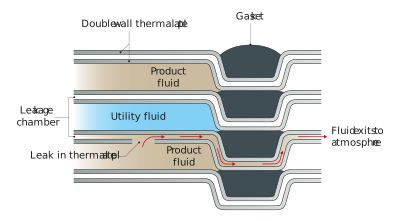
Figure: Double-wall plates showing leakage chamber exiting to atmosphere
Gasket-free plate heat exchangers
There are plate exchangers that do not use gaskets and therefore, reduce the risk of product contamination. One such exchanger, shown in the image below is the brazed plate heat exchanger (BPHE). Here the exchanger plates are brazed together rather than sealed with gaskets. This, however, means that the exchanger cannot be opened for cleaning or maintenance purposes.
Brazed plate exchangers are a popular choice for small scale brewing applications such as home and craft brewing.
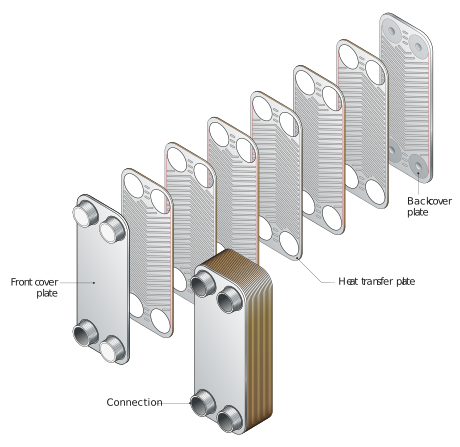
Figure: A brazed plate heat exchanger
Now that we know how a plate heat exchanger is constructed, let’s move on to see how it operates.