
Lesson 8 - Heat Exchangers
This lesson focuses on the two main heat exchangers found in breweries, namely plate heat exchangers and shell and tube heat exchangers. The lesson will examine the components, assembly, and operation of these exchangers. It will also discuss how to select and size a heat exchanger and the considerations for cleaning, maintaining, and operating heat exchangers in the brewing process.
Point of Reflection – Reconvene
Welcome back. So, what were your thoughts?
Did you observe that the shell-side fluid passes just once through the exchanger whereas the tube-side fluid passes through twice? Did you observe the flow configuration to be cross- /countercurrent hybrid as presented earlier in this lesson?
The figure below shows a shell and tube exchanger with the following multiple passes:
-
Four tube-side passes (marked in red)
-
Two shell-side passes (marked in blue)
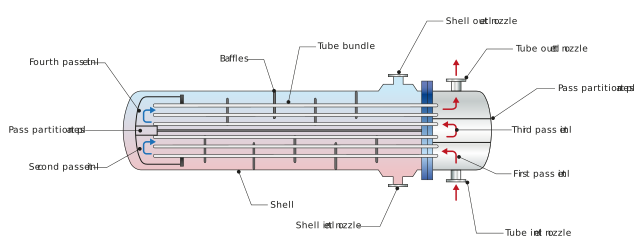
Figure: 2-4 shell and tube exchanger (2 shell passes and 4 tube passes)
By default, U-tube exchangers, like the one in the video, are always two-pass tube heat exchangers. In fixed tubesheet and floating head exchangers, partitions located in the header ends are used to achieve multiple passes on the tube side. A horizontal baffle is used to achieve multiple passes on the shell-side of the exchanger.
Shell and tube exchangers used as evaporators in brewery refrigeration plants can have up to six tube passes. In other industries such as oil, shell and tube exchangers can have as many as sixteen tube passes.
We really are making progress! You now have a thorough understanding of not one, but two major types of heat exchangers used in brewing.
How are your energy levels? Let’s keep them up as we enter into the next sections of this lesson where we consider the selection and sizing of heat exchangers.