
Lesson 8 - Heat Exchangers
This lesson focuses on the two main heat exchangers found in breweries, namely plate heat exchangers and shell and tube heat exchangers. The lesson will examine the components, assembly, and operation of these exchangers. It will also discuss how to select and size a heat exchanger and the considerations for cleaning, maintaining, and operating heat exchangers in the brewing process.
Principles of Heat Transfer in Heat Exchangers
All aspects of heat exchanger design are focused on how to maximise heat transfer. Before we look further into the types, components, and operation of heat exchangers, let us revisit some key heat transfer principles related to heat exchanger design.
In the Radiation and Combined lesson, you were introduced to the relationship that governs heat transfer in a multi-layer system such as a heat exchanger:

Let’s look at each element in detail and how they influence the design of heat exchangers and their components.
Heat transfer surface area
The greater the heat transfer surface area (A), the greater the heat transfer rate. However, the larger a heat exchanger, the more costly it is.
The design of heat exchangers and their components is heavily focused on maximising the heat transfer area while minimising the total size of the heat exchanger.
Overall heat transfer coefficient
The greater the overall heat transfer coefficient (U), the greater the heat transfer rate. In the lesson on Radiation and Combined, we showed that the overall heat transfer coefficient for a heat exchanger is defined as:

In heat exchanger design, the most effective way to increase the overall heat transfer coefficient is to:
-
Maximise turbulent flow – turbulent flow means that the flow in the exchanger is highly mixed, which increases the film transfer coefficient (h1 and h2). Turbulent flow also introduces a degree of self-cleaning through the heat exchanger, which reduces fouling resistance (r).
-
Minimise stagnant zones – stagnant zones lower film transfer coefficients (h1 and h2). They also become the first place where fouling develops, thus increasing fouling resistance (r).
-
Reduce transfer plate thickness (x) and select a material with a good conductivity (k).
Maximising turbulent flow and minimising stagnant zones has a far greater influence on overall heat transfer coefficient than plate thickness and material conductivity. This is important to know when designing heat exchangers with optimum heat transfer rates.
Pressure drop is a counterbalance to good overall heat transfer coefficient. As turbulence through the heat exchanger increases so too does the pressure drop. The pressure drop through an exchanger must be overcome by upstream pumping of the exchanger fluids, which can be costly. A well-designed heat exchanger finds a balance between good heat transfer coefficient and an acceptable pressure drop.
Temperature driving force
Heat can only be transferred from a higher temperature to a lower temperature. It will never flow from a lower to higher temperature.
The temperature driving force, ΔT, is the difference in temperature between the hot and cold fluids in the exchanger and is the driving force for heat transfer across the exchanger. This is important in heat exchanger design because the greater the temperature driving force, the greater the heat transfer rate.
Put another way:
-
For a required heat transfer rate (q), the greater the temperature driving force (ΔT), the smaller the required heat exchange area (A).
Approach temperature is when the temperature of the product fluid leaving the exchanger approaches that of the utility fluid, thus reducing the temperature driving force.
In a heat exchanger there is also a change in temperature of each fluid between when it enters and leaves the exchanger, as a result of the heat transferred to or from it. This ΔT is within a single fluid and is different from the ΔT across the two fluids described above. It is not a driving force for heat transfer.
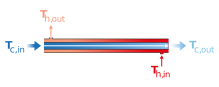
Figure: Temperature difference and temperature driving force in a heat exchanger
In the figure above the temperature change of the fluids is the difference between Tc,in and Tc,out or between Th,in and Th,out. The temperature driving force is the difference between Tc,in and Th,out or Th,in and Tc,out.
Now that we have reviewed some of the key heat transfer principles as they apply to heat exchanger design, let’s look at how exchangers can be designed for different flow configurations.