
Lesson 8 - Heat Exchangers
This lesson focuses on the two main heat exchangers found in breweries, namely plate heat exchangers and shell and tube heat exchangers. The lesson will examine the components, assembly, and operation of these exchangers. It will also discuss how to select and size a heat exchanger and the considerations for cleaning, maintaining, and operating heat exchangers in the brewing process.
Types of Shell and Tube Heat Exchangers
There are three main types of industrial-scale shell and tube heat exchangers. They all use the same basic components introduced in the previous section. However, each has its own unique characteristics, advantages, and disadvantages.
Fixed tubesheet exchanger
The first type is called a fixed tubesheet exchanger. In this exchanger, both the tubesheets are welded to the shell. This makes them simple and cost-effective to construct. However, there are two major disadvantages to fixed tube exchangers:
-
The outside of the tubes is never accessible for cleaning. This exchanger is only suitable if the designer is confident that the shell-side fluid will not foul or scale.
-
If a large temperature difference (generally greater than 50°C) exists between the shell and tube materials, the expansion of the metals can cause excessive stress, which can damage the exchanger. The image below shows a fixed tubesheet exchanger with an expansion joint in the shell. This can eliminate excessive stress from expansion. However, such joints are often a source of weakness and failure.
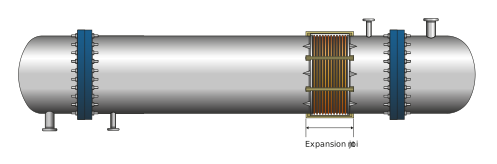
Figure: Fixed tubesheet shell and tube exchanger with an expansion joint
Floating head exchanger
There are also shell and tube exchangers where the tubesheet at the rear header end is moveable. These exchangers are called floating head exchangers. Using a floating head allows for thermal expansion as well as removal of the tube bundle for cleaning. This makes them the choice exchanger for high-fouling shell-side fluids. A floating head exchanger is the best choice in terms of optimal heat transfer rate and maintenance but is typically 25% more expensive than the equivalent fixed tubesheet exchanger.
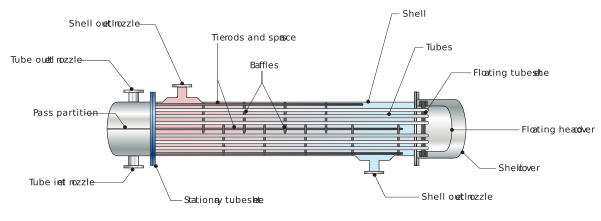
Figure: A floating head shell and tube exchanger
In the image above the floating head is on the right-hand side. The floating tubesheet and header end ‘float’ inside the shell cover and are both removable.
In the previous section, we watched a video clip on the assembly of a fixed header type shell and tube exchanger. Watch the video below to see the assembly of a floating header type shell and tube. You can see the difference between the two types of exchangers. Note, this is for illustrative purposes only and is not a recommendation or endorsement of the supplier’s product.
U-tube exchanger
The third type of exchanger is the U-tube shell and tube heat exchanger, as shown in the image below. At the end of the first pass, the tubes do a hairpin bend and re-enter the shell section for the second pass. The U-tube configuration only requires one tubesheet which lowers the cost of the exchanger. The U shape of the tubes permit unlimited thermal expansion, and the tube bundle can be removed for cleaning. U-tube exchangers should only be used for relatively clean tube side fluids as the U-bend makes the tubes difficult to clean.
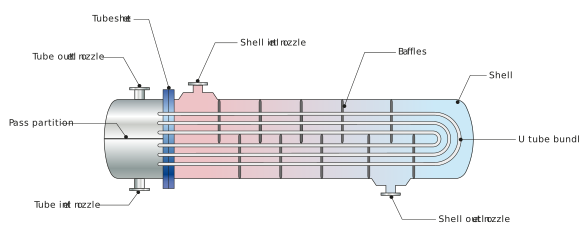
Figure: U-tube shell and tube exchanger
Double-pipe heat exchangers
Double-pipe heat exchangers are smaller, simpler, and less expensive versions of the industrial shell and tube exchanger we have discussed so far. They are easy to fabricate, repair, and upgrade but are less efficient, limited to lower heat duties, and difficult to clean. Typical fluid flow in a double-pipe heat exchanger is shown in the figure below.
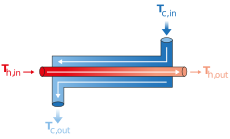
Figure: A double-pipe heat exchanger fluid flow
The image below shows a version of a double-pipe exchanger made for use as a home brewing wort cooler.
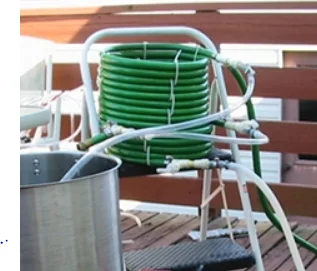
Figure: A self-made shell and tube exchanger being used for wort cooling by a home brewer
Now you have a good overview of the different types of shell and tube exchangers, their components and assembly, we can explore the design of the tubes themselves in more detail.