
Lesson 8 - Heat Exchangers
This lesson focuses on the two main heat exchangers found in breweries, namely plate heat exchangers and shell and tube heat exchangers. The lesson will examine the components, assembly, and operation of these exchangers. It will also discuss how to select and size a heat exchanger and the considerations for cleaning, maintaining, and operating heat exchangers in the brewing process.
Plate Heat Exchanger Gaskets
Gaskets are what give this exchanger one of its unique advantages. They allow for an exchanger that seals tightly, does not leak and can be easily opened for cleaning and maintenance. In this section, we look closely at the features of these important components.
In the figure below we can see that there are three gasket positions. Together, these serve two key functions:
-
The outer edge gasket (shown in green) ensures no fluid leaks out of the exchanger.
-
The gaskets around the distribution passage holes (shown in blue) and the flow channel (shown in red) determine which fluid flows across each plate and the direction of this flow. When the gasket is present it ensures that no fluid passes from the distribution channel into the flow channel. When the gasket is not present the fluid flows freely from the distribution channel across the exchanger plate.
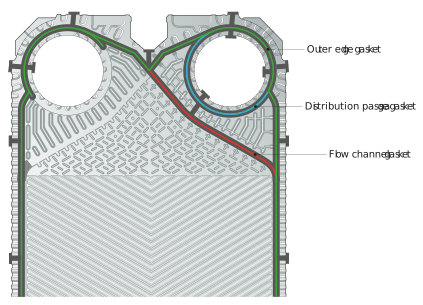
Figure: The location of the gasket in a plate heat exchanger
A plate has channels pressed into it where the gasket sits. The adjacent plate will have the same channels so that when placed and squeezed together, the gaskets fit tightly and form a watertight seal.
Watch the video below to see how the plates are packed together. Note, this is for illustrative purposes only and is not a recommendation or endorsement of the supplier’s product.
Gasket features
The shape, height, and width of the gasket are configured to suit the specifics of the heat exchanger and its intended duty. The selection of gasket material is critical to the durability of the gasket. For brewing applications, gaskets are usually made from EPDM, which is a common elastomer. Gaskets should have the following features:
-
Compressible so it can return to its original shape when the plates are opened
-
Strong enough to withstand the pressure when the plate pack is tightened as well as the operating pressure of the product and utility fluids
-
Soft enough to conform closely to the metal surfaces and provide a seal without the plates having to be unduly tightened
-
Resistant to penetration by the process or utilities fluid
-
Maintain its properties over the full operating temperature range of the exchanger. When gaskets are operated below their design temperature, they become brittle and crack
-
Hygienic and food grade so there is zero risk to the integrity of the process fluid
Plate heat exchanger suppliers are constantly improving the design of heat exchangers and their components to make them more efficient, reliable, and easier to maintain. You can visit some of these supplier websites to view their latest developments. Note, this is for illustrative purposes only and is not a recommendation or endorsement of the supplier’s product.
https://www.alfalaval.com/microsites/demand-new-standards/
https://www.kelvion.com/za/products/product/plate-features/
Now that you know about the various components of plate heat exchangers let’s look at one of their biggest risks, product contamination.