
Lesson 8 - Heat Exchangers
This lesson focuses on the two main heat exchangers found in breweries, namely plate heat exchangers and shell and tube heat exchangers. The lesson will examine the components, assembly, and operation of these exchangers. It will also discuss how to select and size a heat exchanger and the considerations for cleaning, maintaining, and operating heat exchangers in the brewing process.
Plate Heat Exchangers
The plate heat exchanger is by far the most common exchanger in the food and beverage industry for product heat transfer. In this section, we will look at the components, assembly, and design of these heat exchangers.
We will examine how the plate heat exchanger is designed to:
-
Create high fluid velocities and thin fluid films along the transfer surface, making them highly efficient at heat transfer
-
Be highly flexible regarding capacity, design conditions, and flow configurations
-
Have smooth internal surfaces, be cleaned inline, and easily opened for deep cleaning, making it hygienic
In this lesson, we will primarily explore one type of plate heat exchanger, the gasketed-plate heat exchanger, as these are the most commonly used in large scale breweries. It is called this because gaskets are used as a seal between the plates, shown on the next page. The figure below illustrates a range of gasketed-plate heat exchangers.
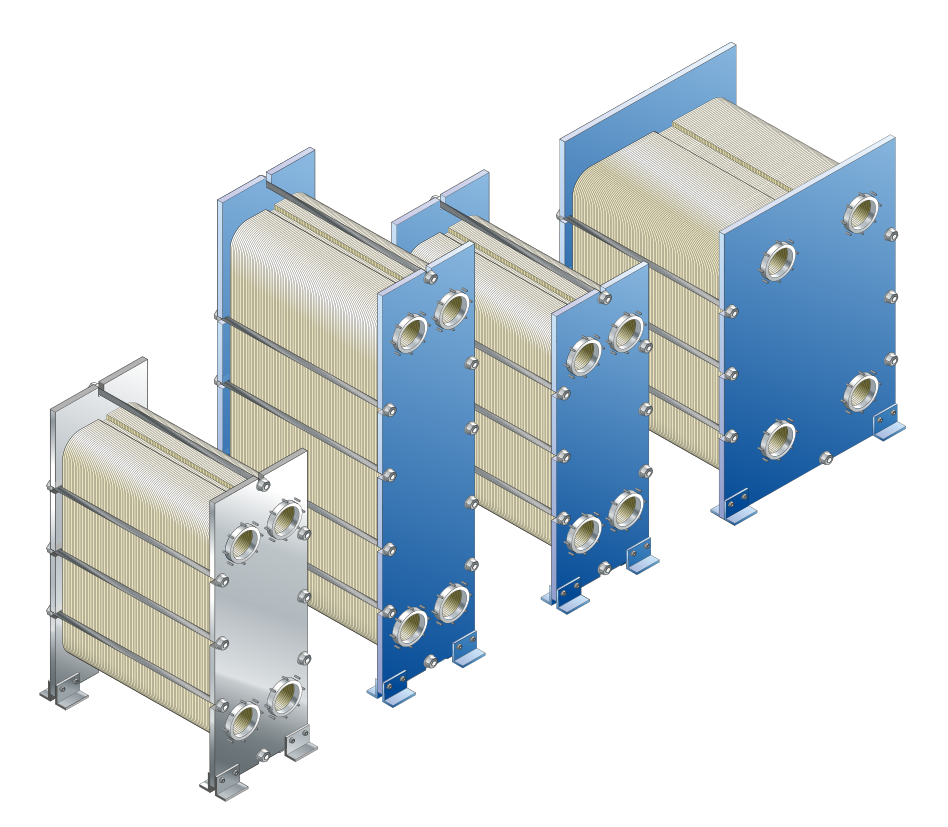
Figure: Range of typical plate heat exchangers in different sizes and materials of construction