
Lesson 8 - Heat Exchangers
This lesson focuses on the two main heat exchangers found in breweries, namely plate heat exchangers and shell and tube heat exchangers. The lesson will examine the components, assembly, and operation of these exchangers. It will also discuss how to select and size a heat exchanger and the considerations for cleaning, maintaining, and operating heat exchangers in the brewing process.
Heat Exchanger Passes
The number of passes refers to the number of times a fluid will pass through the length of the exchanger. Either one or both fluids in an exchanger can have multiple passes. Let’s explore this useful design characteristic of heat exchangers a little more.
Exchangers for small applications generally have just single passes, as shown in the figure below. In larger industrial applications, between two- and six-pass exchangers are more common, as also shown below. The number of passes is typically an even number.
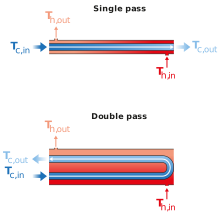
Figure: Single and two-pass flow configurations
There are two major reasons multi-pass exchangers are considered in exchanger design.
1. For the same heat transfer area, the heat transfer path in a multi-pass exchanger is longer and narrower than in a single-pass exchanger. This means the same amount of fluid is now squeezed through a much smaller space over a longer distance, which has two major influences on the performance of the heat exchanger.
-
It increases the fluid velocity, which improves the turbulence. As we have already learned, this increases the overall heat transfer coefficient.
-
Unfortunately, it also increases the resistance to fluid flow which results in a higher pressure drop through the exchanger.
2. Multi-pass heat exchangers are used when the change in temperature of one fluid across the exchanger is far greater than that of the other and the flowrates of the fluids cannot be adjusted to compensate for this. This is explained further in the two temperature profiles below:
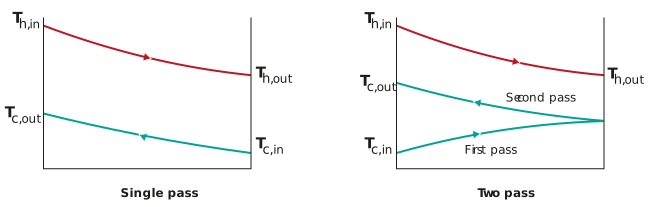
Figure: Temperature profile of a single-pass (left) and two-pass (right) exchanger
The profile on the left-hand side is of a single-pass, countercurrent exchanger. In the profile on the right, the first fluid passes back through the exchanger for a second pass. The change in temperature (Tc,in to Tc,out) of the first fluid in the two-pass exchanger is far greater than that in the single-pass exchanger.
Look closely again at the flow configuration and temperature profile of a two-pass exchanger in the images above. What do you notice about the flow direction of the two streams? In multi-pass exchangers, flow configurations are not simply co-current or countercurrent. You can see in this image that the first pass is co-current flow, and the second pass is countercurrent; this is a hybrid flow configuration.
Generally, heat exchangers are described by the number of passes, its flow configuration, and the type of heat exchanger. For example, we can have a two-pass, countercurrent shell and tube heat exchanger or a single-pass, co-current plate heat exchanger.
Are you feeling sufficiently warmed up now?
In the next part of this lesson, we will look at both the plate and shell and tube heat exchangers in more detail. We will begin with the plate exchanger and explain its components and assembly then explore how its numerous configuration and design elements make it so popular for brewing applications.