
Lesson 8 - Heat Exchangers
This lesson focuses on the two main heat exchangers found in breweries, namely plate heat exchangers and shell and tube heat exchangers. The lesson will examine the components, assembly, and operation of these exchangers. It will also discuss how to select and size a heat exchanger and the considerations for cleaning, maintaining, and operating heat exchangers in the brewing process.
Point of Reflection – Reconvene
Welcome back. So, what were your thoughts?
Basically, inline heat exchangers exist anywhere wort or beer is heated up or cooled down while being transferred from one point to another.
-
In the brewhouse, this includes wort pre-heating, wort kettle external or internal heating, wort kettle energy recovery, and wort cooling.
-
In the beer processing area, this includes yeast chilling, external fermenter cooling, green beer transfer (from fermenter to maturation vessel), and beer chilling (before and after filtration).
-
Inline heat exchangers are also used where beer or wort is not the product stream, such as heating for cleaning in place (CIP) processes, hot water heating, and water deaeration.
-
You may also notice small heat exchangers included in pre-assembled/skid-mounted equipment such as a small water cooler on a beer centrifuge skid.
In heat exchangers there are two fluids, namely a product fluid and a utility fluid. We use the term 'product' to describe the stream that is not the utility stream. Often the product stream is wort or beer, but it can also be water or CIP solution.
In the examples given above energy is transferred between the product and utility stream. If the purpose of the exchanger is to heat up the product fluid (e.g. wort in a wort kettle) then the utility fluid will be hot steam or water. If the purpose is to cool down the product fluid (e.g. wort prior to fermentation) then the utility fluid will be cold such as chilled water, glycol or liquid ammonia.
This lesson will focus on the two main inline heat exchangers found in brewing: the plate heat exchanger (PHE) and the shell and tube heat exchanger. Due to their high heat transfer rates and flexible design, plate heat exchangers have become the preferred choice for process heat exchangers in brewing. The figure below shows a typical plate heat exchanger being used for wort cooling.
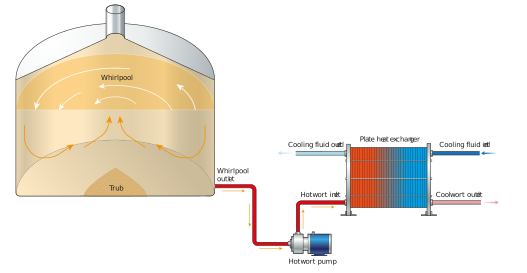
Figure: A plate and frame heat exchanger used in wort cooling
Historically, shell and tube heat exchangers were the only type of exchanger used in brewing. However, these days, while they are still the preferred heat exchanger for wort boiling as shown in the figure below, they are now mostly used as utilities heat exchangers.
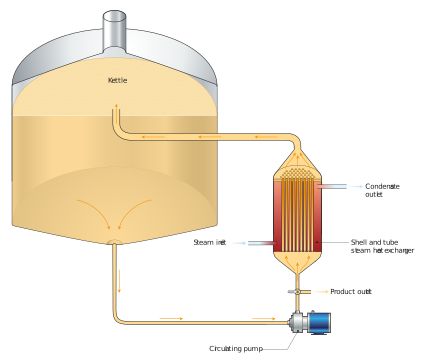
Figure: A shell and tube heat exchanger used as an external heater for a wort kettle
Now you are familiar with what a heat exchanger is and where it is used in the brewing process, lets revise some concepts about heat transfer and how they apply to heat exchangers.