
Lesson 4 - Malting Process
This lesson deals with the malting process. We investigate each stage of the malting process in detail. We describe the required physical and biochemical changes involved in the conversion of barley to malt. We also discuss the vessels used for malting and explain how they help to produce malt of optimum quality.
Tests Before Steeping
Before maltsters commit to steep a batch of barley, they must be confident it has the ability to germinate. In this section we describe the tests they use to gain that confidence.
Germinative capacity test
The germinative capacity (GC) test involves cutting 100 grains longitudinally and then staining them with a tetrazolium dye. The GC test is usually undertaken when barley is delivered to the malt plant to check whether it is acceptable for intake. Living embryos stain pink, while dead embryos remain white or discoloured.
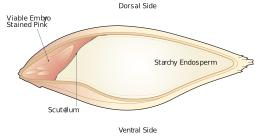
Figure: GC tetrazolium stain on a viable barley kernel
In the malt plant laboratory it is more common to use the GC peroxide test. Here, two sets of 200 grains are soaked in a 0.75% hydrogen peroxide solution. After two days, the hydrogen peroxide is changed for a fresh solution. The percentage of grains that have germinated (chitted) is counted after four days. This should be > 98% and preferably 100%.
The GC test results tell us how much of the barley is alive. However, just being alive doesn’t guarantee that grain will germinate as required. The ability of the grain to germinate is referred to as the germinative energy (GE) test. If grains have a low GC result there is little point measuring GE because insufficient grains are alive (viable) and dead grains don’t germinate!
Germinative energy (GE) test
In the GE test 100 grains are wetted (4 mL of water is used in the standard test) and checked for rootlet growth each day for three days. The percentage showing rootlet growth on each day is recorded.
The difference between the GC result and the GE result is a measure of dormancy. During barley storage, as grain dormancy declines the GE gradually increases until it is very close or equal to the GC.
Dormancy is a natural protective mechanism in seeds, which prevents them germinating under a false start, for example after sporadic rainfall in a dry season. Dormancy varies from variety to variety and some are always slow to start germination. Newly harvested barley should have an in-built dormancy as this avoids germination on the mature barley plant after rainfall (pre-germination). Barley with high dormancy must spend more time in storage facilities, until the natural dormancy breaks and it can be malted. Dormancy naturally breaks or declines with time, or it can be removed more quickly by the heat introduced during the drying process. Modern barley varieties have quite short dormancy periods and can be ready for malting within 1-2 months post-harvest.
Water sensitivity is a similar phenomenon to dormancy and is thought to be due to microorganisms competing with the embryo for oxygen. Water sensitive grains do not germinate when there is an excess of water. We test for water sensitivity by using the same method as the GE test but we add 8 mL of water instead of 4 mL. Both tests are undertaken at the same time.
Water sensitivity is calculated using this equation:
Water sensitivity = number of germinated grains in 4 mL test - number of germinated grains in 8 mL test
It is important to test the grain for water sensitivity before steeping, as you can guarantee there will be excess water in the steep and poor germination may result! Water sensitivity is a natural phenomenon and declines or disappears with grain storage in most varieties. Some barley varieties and barleys grown in certain geographical locations can be water sensitive even after storage. With these, we need to use a modified steeping process with longer air rests.
The grain is now checked and tested and is ready for steeping. Next, we find out what changes occur in the grain while it is in the steeping process.