
Lesson 4 - Malting Process
This lesson deals with the malting process. We investigate each stage of the malting process in detail. We describe the required physical and biochemical changes involved in the conversion of barley to malt. We also discuss the vessels used for malting and explain how they help to produce malt of optimum quality.
Physical and Chemical Changes During Steeping
As it germinates, a dormant kernel changes into an actively growing grain. Major changes in metabolism and structure occur.
The grain respires, converting sugar from the endosperm into energy for plant growth. The by products are: CO2, water and heat. These are shown in the respiration equation below:
C6H12O6 (glucose) + 6O2 (oxygen) ----> 6CO2 (carbon dioxide) + 6H2O (water) + 36 ATP (energy) + Heat
In the steeping process, the grain uses the oxygen dissolved in the water but this is not enough to sustain growth. Most of the oxygen required is provided during air rests. The maltster must remove CO2 and heat and provide oxygen.
We know that an increase in moisture triggers germination. What would happen if only a small section of the endosperm was hydrated?
The enzymes that catalyse the breakdown of the cell walls and protein matrix need water in order to work. If only a section of the endosperm is hydrated, the enzymes are only able to access that section. This gives uneven endosperm modification.
To ensure even modification, the whole kernel must be sufficiently hydrated. The ideal moisture level for germination is between 43-46% (in the whole kernel!).
Water enters the grain through the micropyle. The water moves from areas with high water concentrations to areas with a lower water concentration. The semipermeable membrane covering the embryo allows water to flow into the grain and prevents the sugar molecules from leaving.
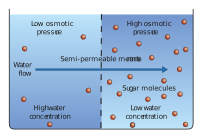
Figure: Osmosis
The embryo hydrates faster than the surrounding tissue. The water uptake diagram below shows water uptake and movement. Most of the water enters the grain via the micropyle.
.
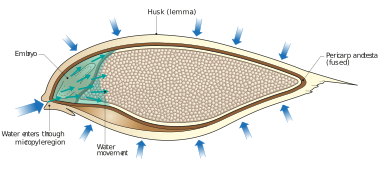
Figure: Water uptake pattern in barley kernel