
Lesson 4 - Malting Process
This lesson deals with the malting process. We investigate each stage of the malting process in detail. We describe the required physical and biochemical changes involved in the conversion of barley to malt. We also discuss the vessels used for malting and explain how they help to produce malt of optimum quality.
Steeping Technology
Barley is cleaned a number of times from harvest to steeping to remove foreign material. Before it is transferred to the steep vessel, it may undergo another cleaning process to remove material deposited on its surface.
Barley for malting must be free from stones, metal, foreign seed and other material (dust, broken grains, husks and stalks). Metal objects and stones can damage equipment and are removed by screens and destoners. Ferrous metal is removed using powerful magnets. Objects that are smaller or larger than the specified kernel size are removed by screens, cleaners and dressers.
Mixing the barley with water can be done in several ways:
- Dry grain is transferred to the steep vessel, and water is pumped in afterwards.
- Water/barley mixing vessels, mix the barley and water at the correct ratio and pump into the steep vessel.
- Barley washers clean the grain and start the hydration process.
A steeping vessel must achieve the following:
- Hydrate the grain.
- Remove CO2.
- Remove toxic metabolites.
- Remove competitive microorganisms e.g. fungi that could be present on the husk.
- Remove excess heat.
- Provide oxygen.
- Enable air rests where the grain is drained.
Conical steeps
The figures below show the key features of a conical steep and the top of a row of conical steeps.
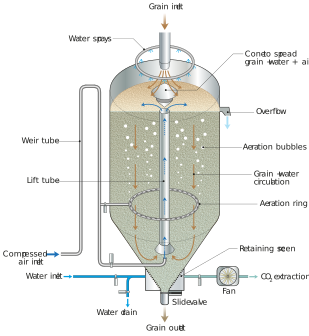
Figure: Features of a conical steep
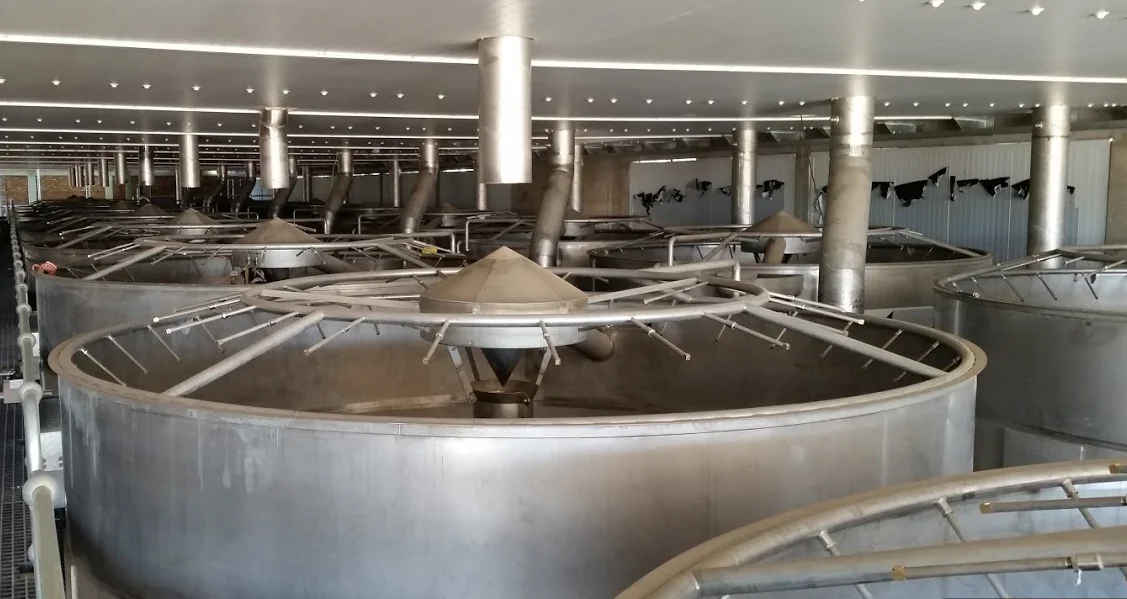
Figure: Two rows of 10 x 35 t conical steeps
Conical steeps are not conical. They are in fact cylindroconical. The cylindroconical shape makes emptying vessels easier as the grain flows out by gravity without needing a push from a mechanical arm. They are usually constructed from stainless steel and have a smaller capacity than flat-bottom steeps.
Flat-bottom steeps
Flat-bottom steeps can be designed for different duties:
- Steeping only
- Combined steeping and germination (SGV)
- Combined steeping, germination and kilning (SGKV)
SGVs and SGKVs have largely fallen out of favour as their design has to compromise between the requirements of the different stages. These vessels require a very high volume of water as we must fill the larger underfloor area (plenum). Structural stresses, induced by the cycling between low and very high temperatures, cause the vessel to crack, which means we need to repair them frequently and replace them sooner than is the case with dedicated steeping vessels.
Flat-bottom steeps differ from a conical steep in that they incorporate a levelling and discharge device.
The vessels are constructed from stainless steel or from concrete with a stainless steel lining. The floor is usually constructed from wedge wire, which has long thin slots through which water can flow but barley cannot. The following figures show a flat-bottom steep with a false floor (labelled as perforated deck) and the Giracleur operating in a flat-bottom steep.
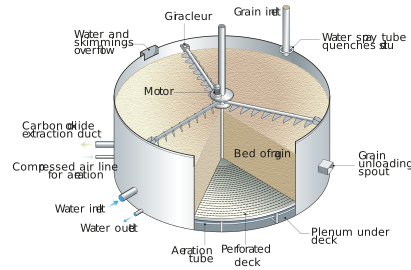
Figure: Single flat-bottom steep
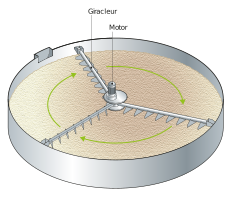
Figure: Giracleur in a flat-bottom steep
Now we have met the steep types, we can discuss how they are operated.
Filling
We transfer barley into the steeping vessel from above. The barley can be dry or, if we are using a barley washer or mixer, pre-wetted. A barley mixer is installed under a holding bin and combines the dry barley from the bin with water, enabling the slurry to be pumped wet to the steeping vessel. Filling the steep with a grain slurry is less damaging to the grain and produces less dust than adding dry grain. The figure below shows such a mixer.
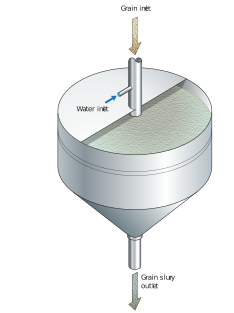
Figure: Barley water mixing vessel before steep
If we are transferring it dry, we can spray the incoming stream of barley with water from a dust suppression ring to limit the amount of dust produced.
When filling a large flat-bottom steep vessel with dry grain, we introduce water at the base of the vessel to cover the barley as it is added. We level the barley with a rotating three-armed leveller and discharge device called a Giracleur or Rotoscraper which prevents dry pockets of grain being formed.
With wet transfer into a conical steep, the grain/water mixture passes over a loading spreader to facilitate even mixing. This is shown in the short video below.
Video: Wet transfer into a conical steep tank
Draining
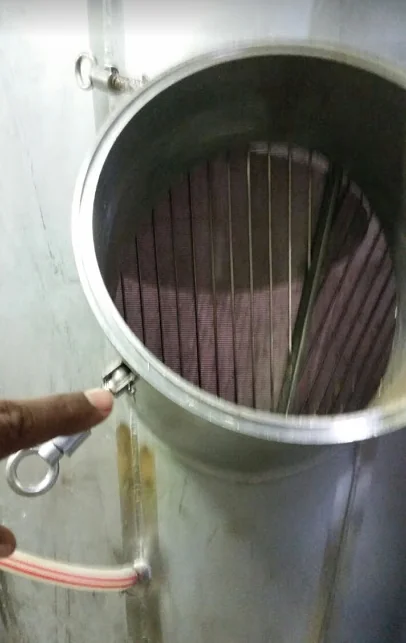
Both types of steep vessel have a supporting screen that holds the barley while water fills or empties from it. In a flat-bottom steep, this screen is a perforated or wedge wire false floor that is supported just above the base of the vessel.
In a conical steep, the wedge wire screen surrounds the cone section and stops the barley escaping the steep vessel while it drains water for the air rests. These screens are shown in the figure below.
Ventilation
We need to ventilate the barley in immersion (wet) and drained (dry) stands in the vessel. Flat-bottom steep vessels have aeration nozzles beneath the perforated floor and on the vessel sides.
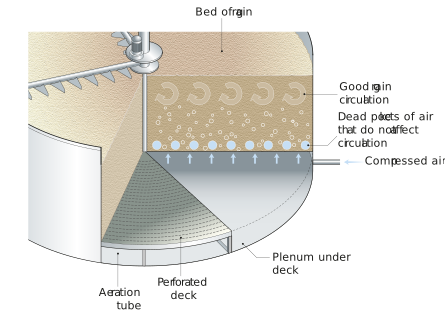
Figure: Aeration in a flat-bottom steep
In conical steeps, aeration is through nozzles or an aeration ring in the cone of the vessel. These vessels may also have a mixing tube in the centre of the vessel extending from the top to the cone. Compressed air is blown into the tube drawing in the water/grain slurry. This helps to mix the contents of the steep as shown in the earlier figure. The barley at the bottom of the vessel is drawn up the tube and deposited on the surface via the loading spreader. In flat-bottom steeps, this mixing is performed by the aeration nozzles, where mixing is generally easier because of a shallower bed depth.
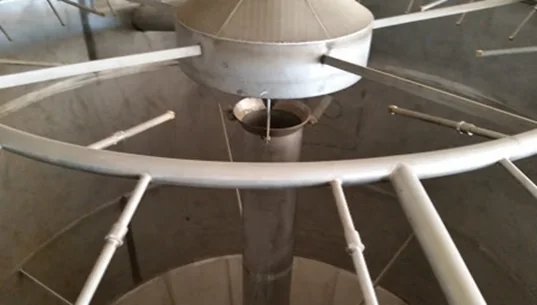
Figure: Conical steep mixing tube and spreader
During the air rests the barley respires more vigorously, heating up and producing CO2. This must be removed and replaced with fresh air to prevent a lack of oxygen, otherwise respiration slows and eventually stops. A lack of oxygen slows α-amylase enzyme production dramatically. In an atmosphere containing 80% CO2, the barley chits but embryo development is severely impaired.
In a flat-bottom steep, air is blown in from underneath or above. In a conical steep, an external fan draws air through the grain bed from below.
During the air rest the addition of fresh air serves three purposes:
-
Removal of CO2
-
Removal of heat
-
Provision of oxygen