
Lesson 4 - Malting Process
This lesson deals with the malting process. We investigate each stage of the malting process in detail. We describe the required physical and biochemical changes involved in the conversion of barley to malt. We also discuss the vessels used for malting and explain how they help to produce malt of optimum quality.
Point of Reflection – Reconvene
Welcome back. So what were your thoughts?
Increasing the moisture or temperature increases the rate of modification. Generally, the higher the temperature, the higher the rate of enzyme activity. However, protease enzyme activity can be reduced at higher germination temperatures. We cannot modify barley properly if one of the groups of enzymes has not been allowed to operate at its optimum temperature. That is why higher temperatures are normally only used towards the end of germination, not the start.
During the germination process moisture level and acrospire growth are measured to determine if the grain is modifying at the required rate.
The acrospire growth test is a relatively simple in-process quality check. Kernels are boiled in a copper sulphate solution. This makes the acrospires visible through the husk; their length indicates the extent of modification. The kernel is divided into four sections, and the length of the acrospires is visually determined. The length of the acrospires, compared to the length of the kernel, is reported as: 0-1/4, 1/4-1/2, 1/2-3/4, 3/4-1 and > 1.
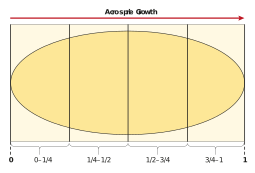
Figure: Scale of acrospire growth in a barley kernel
If the majority of the acrospires are in the 0-1/4 range, they are either dead or growing slowly. Kernels whose acrospires are longer than the kernel (> 1) are considered over modified. We need all acrospires to be the same length as this helps ensure the finished malt is uniform across the batch.