
Lesson 4 - Malting Process
This lesson deals with the malting process. We investigate each stage of the malting process in detail. We describe the required physical and biochemical changes involved in the conversion of barley to malt. We also discuss the vessels used for malting and explain how they help to produce malt of optimum quality.
Processing Factors and Control - Kilning
Enzymes are considerably more resistant to heat when the malt is dry. We can therefore accomplish our kilning objectives with a controlled drying regime that removes most of the moisture at lower temperatures. Later, once the moisture level is reduced and the enzymes are less vulnerable, we use more intense heating to achieve the target moisture level and colour/flavour production.
The kilning programme commences with blowing fresh, dry hot air through the moist grain bed from underneath. Kilning control can be divided into three distinct phases. These are:
- Free drying
- Forced drying
- Curing
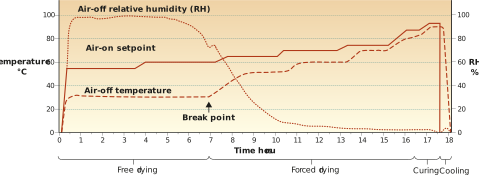
Figure: The stages of the kilning process
During these stages we can measure three parameters to allow us to control the process:
- Air-on temperature (air temperature being fed to the grain bed)
- Air-off temperature (air temperature leaving the grain bed)
- Relative humidity (RH) (the amount of water vapour in the air leaving the bed)
RH is not measured by all maltsters because RH probes can become inaccurate when dusty.
The two main process elements we can vary to affect these parameters are fan speed and the temperature of the drying air.
Free drying
The moisture on the kernel surface is loosely held by the grain and is therefore easily removed by the air flow. The warm, dry (low relative humidity) air at lower temperatures and high fan speeds achieves this alone. Air-on temperatures around 50-60˚C are used and can be as low as 40˚C for highly enzymatic malt. During this time, the moisture level of the malt is dropping at a constant rate, and the flow of fresh air is carefully controlled. The air-off RH remains constant at > 95% water-saturated, and air-off and grain temperatures are in the region of 25-30˚C due to the cooling effect of the moisture evaporating. It is important to note that recirculation of high humidity warm air at this stage damages the malt enzymes. This is a bit like when you steam vegetables above hot water to cook them.
In order to evaporate water from the surface of the grain, we need both rapid airflow and an input of energy called the latent heat of evaporation. This energy is required to break the links between the water molecules and hence turn the water into vapour. Because we need to break these links, this is more than the energy than would be required to heat the same amount of a solid object or air to the same temperature (the sensible heat). We must therefore heat the incoming kiln air to supply both the sensible heat to heat the water and the latent heat to evaporate it. This hot air cools down as it transfers energy into the film of water on the surface of the grain, and the malt warms up until it reaches the same temperature.
Latent heat is why you feel cold when you get out of a swimming pool. Your body loses heat as it causes the water to evaporate. The heat that is lost is the latent heat of evaporation of the swimming pool water!
The saturated air now leaving through the kiln exhaust has a much higher moisture level than the incoming fresh air. The water in the exhaust can be condensed using a heat exchanger, where it gives up its stored energy as the latent heat of condensation.
In kilning, different layers of the malt bed are at different stages of drying. The driest layer is at the bottom of the bed and reaches the forced-drying phase while the upper layers are still in the free-drying phase. The progression of drying from bottom to top is called the drying front. For this reason, the bed in the kiln is shallower than the bed in germination.
The different layers of drying in a kiln bed are shown in the figure below. The drying front is the hatched line above the free-drying zone.
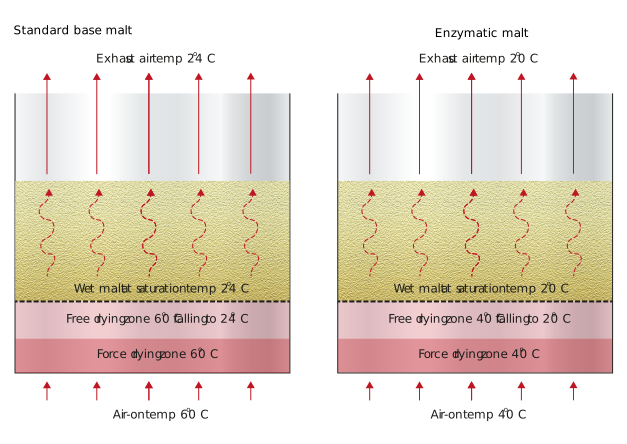
Figure: Layers of drying in a kiln bed
Forced drying
The second phase of drying occurs when the bottom of the free-drying zone reaches or breaks through the top of the malt bed, causing the air-off temperature to suddenly increase. This rise in air off temperature is called the break point. All the moisture on the surface of the grain has been evaporated, so the air leaving the grain is no longer being cooled. Not only does the air-off temperature reach a level that is closer to the air-on temperature, the RH decreases as the air is less saturated with water. At break point, the level of moisture inside the grain falls below 12-18%. After the break point, we increase the air-on temperature in steps to 65-75˚C to force the moisture from the centre of the grain and remove it from the surface. At this point we also control the air-off temperature by reducing the airflow and increasing recirculation of air. The RH of air leaving the bed in forced drying (post break) is low enough to be blended with fresh air for the purposes of drying the grain. Recirculation of this air helps save energy.
Curing
Curing is the period where the malt moisture approaches 5-8% and the air-on temperature is increased to its highest point, typically 78-85˚C for lager malts and, 90-100˚C for ale malts, and up to 105˚C for darker-coloured malts such as Vienna and Munich.
During curing, many of the characteristic colour and flavour compounds are formed. DMS is formed from its precursor SMM and driven off during this phase, which typically lasts for between two and four hours. The kiln air is recirculated during the curing phase.
Cooling
After curing, the malt is cooled down in the kiln to around 30˚C by passing air at ambient temperature through the bed. Cooling the grain quickly and sufficiently is important to prevent additional colour pick up and excessive moisture removal. After cooling, it is discharged from the kiln and undergoes the deculming process to remove the dried rootlets, or culms, and a final cleaning stage to remove dust and foreign material. Conveyors then transfer it to silos
In summary, free drying (also called pre-break) refers to the grain drying stage where the moisture on the surface of the grain is removed. When this is completed, the break point occurs and drying enters the forced-drying phase (post break) where moisture bound in the grain kernel is driven to the surface and removed. During the free-drying stage, embryo growth, modification, and enzyme synthesis continue. After the break, during forced drying, enzymatic activity declines and some enzymes are denatured.