
Lesson 4 - Malting Process
This lesson deals with the malting process. We investigate each stage of the malting process in detail. We describe the required physical and biochemical changes involved in the conversion of barley to malt. We also discuss the vessels used for malting and explain how they help to produce malt of optimum quality.
Germination
The main enzymes involved in modification are those that break down the endosperm cell walls, the protein matrix within the cells surrounding the starch granules, and some of the starch granules themselves. These enzymes also play key roles in the mashing process, where starch breakdown and, to a lesser extent, protein breakdown are completed.
Let’s now remind ourselves of the target for the action of the enzymes of modification, namely the barley endosperm cells containing the barley starch. The cell is a bit like a fortress protecting the starch granules. The β-glucan and pentosan cell walls are strengthened by a protein layer; once they have been broken down, the starch granules inside the cells are still protected by a matrix of protein acting as a shield. This protein must be degraded to expose the starch granules so the enzymes can hydrolyse them. The starch in these granules is in two forms: amylose and amylopectin. The amylopectin is a branched structure and needs limit dextrinase to allow all of it to be converted to sugars.
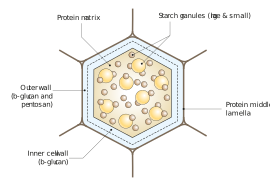
Figure: Barley endosperm cell
Table: Roles of key enzymes in germination
|
Activity |
Enzyme |
Action in Endosperm |
|
Cell wall breakdown |
β-glucan solubilase |
Breakdown of protein in cell walls |
|
Endo-β-glucanases |
Breakdown of viscous β-glucans |
|
|
Pentosanases |
Breakdown of viscous pentosan gums |
|
|
Protein breakdown |
Endo and exoproteases |
Breakdown of protein matrix surrounding starch granules, to make FAN and polypeptides |
|
Starch breakdown |
α-amylase |
Breakdown of small starch granules to produce sugars for embryo growth |
|
β-amylase |
||
|
Limit dextrinase |
The enzymes that the endosperm requires for modification during germination are not all present at the start and become available in sequence. The table below shows the days on which the enzymes first become active in the endosperm.
Table: Sequence of malt enzyme activity
|
Day of Germination |
Malt Enzymes First Activated |
|
Day 1 |
Carboxypeptidase β-Glucan solubilase β-Amylase |
|
Day 2 |
Endo peptidase β-Glucanases |
|
Days 2-4 |
α-Amylase |
|
Days 4-6 |
Limit dextrinase |
Now that we have discussed what the enzymes do, in the next section we explore how this occurs during germination.