
Lesson 4 - Malting Process
This lesson deals with the malting process. We investigate each stage of the malting process in detail. We describe the required physical and biochemical changes involved in the conversion of barley to malt. We also discuss the vessels used for malting and explain how they help to produce malt of optimum quality.
Gibberellic Acid and the Enzymes of Modification
It can be said that barley enzymes are the hardest workers in the malt plant (maltsters may disagree!). For the enzymes to work, the cells producing or activating them need to receive a chemical message. This message is the hormone gibberellic acid (GA).
As the embryo starts to grow, it uses up its energy stores. To continue to grow it must obtain nutrients from the endosperm. For these nutrients to be made available, enzymes must breakdown the storage materials in the endosperm. It is thought that as the sugar level in the embryo falls, the embryo begins to produce GA from a stored precursor. The GA leaves the embryo and flows to the aleurone layer where it stimulates enzyme production.
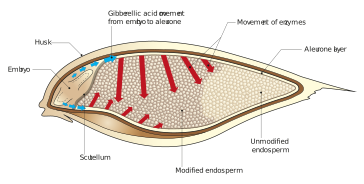
Figure: GA and enzymes
The enzymes which are synthesised de novo (from scratch) in response to GA are listed below along with their substrates:
- α-Amylase – starch
- Limit dextrinase – starch
- Endoproteases – protein
The enzymes that are already present in the grain and are activated during the malting process are listed below along with their substrates:
- Endo β-(1,3)(1,4) glucanase – β-glucans
- Endo β-(1,3) glucanase – β-glucans
- Pentosanase – pentosans
- β-Amylase – starch
- Carboxypeptidases and other exoproteases – polypeptides
- Phytase – phosphate containing compounds
- Lipase – lipids
Key points:
- Steeping increases kernel moisture from ~ 12% to ~ 45%.
- Germination starts at kernel moistures > 30%.
- The chit (first root) that appears after 24 hours is an indication that germination has commenced.
- GA is produced by the embryo from a stored precursor, stimulating the synthesis and activation of enzymes.