
Lesson 4 - Malting Process
This lesson deals with the malting process. We investigate each stage of the malting process in detail. We describe the required physical and biochemical changes involved in the conversion of barley to malt. We also discuss the vessels used for malting and explain how they help to produce malt of optimum quality.
Germination Process
We can adjust two parameters to control germination:
1. The bed temperature - The grain bed temperature (16-21˚C) is controlled by adjusting the air-on temperature (11-16˚C).
2. Moisture in the bed - This is achieved by controlling the relative air humidity in the vessel (> 95% or 100% is better) and spraying the bed.
Temperature control
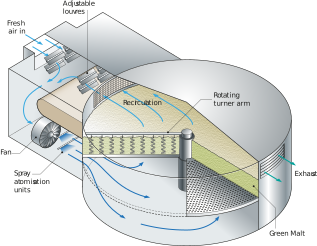
Figure: Circular germination vessel
The above diagram shows the large fans used to force humidified air through the bed. The temperature of the humidified air is called the air-on temperature. Air-on temperature is controlled by chilled water that is sprayed through nozzles, producing a fine vapour. The incoming air temperature is reduced to the set point in the range of 11-16˚C. The air-on temperature is slightly lower than the germination temperature, as it needs to cool the bed, maintaining a temperature of 16-21˚C.
The louvres shown in the figure above control the mixing of fresh incoming air with warmer recirculated air coming off the bed. No more than 80% of recirculated air can be used to control air-on temperatures due to the high levels of CO2 that can reduce the rate of germination.
The temperature above the bed is also monitored using temperature probes. This is called the air-off temperature. The process is controlled to maintain a specific difference between the air-on and air-off temperatures.
Moisture control
Respiration causes the bed’s temperature to increase. The heat generated reduces the grain’s moisture. Grain can lose roughly 0.5% moisture per day. The most active growth, and hence respiration rate, is during the first three days. It is vital to keep the moisture content up at 43-46% during the highest rate of respiration. Water spray nozzles on the turner arm, as shown in the above diagram, maintain bed moisture. The helical screws turn the grain while water is sprayed on to the kernels.
Effect of control parameters
Point of reflection: What effect does moisture and temperature have on germination and the rate of modification? Think about:
- The effect of moisture on modification.
- The effect of temperature on modification.
- The effect of temperature on enzymes.
- The effect of temperature on rate of modification.
Give yourself 5-10 mins to think about this and then click ‘Next’ to continue with this lesson.