
Lesson 4 - Malting Process
This lesson deals with the malting process. We investigate each stage of the malting process in detail. We describe the required physical and biochemical changes involved in the conversion of barley to malt. We also discuss the vessels used for malting and explain how they help to produce malt of optimum quality.
Kilning Technology
Modern kilns are designed to produce high quality malt, using the minimum amount of energy. In this section we look at the design features and functions of kiln technology.
Early designs were often rectangular boxes in a double deck arrangement (over two floors), where the exhaust from the first layer was then directed to the second layer. Some double deck kilns are still used (although each deck has its own control system) but many have a single floor that is very similar to circular germination vessels.
With the exception of GKV’s, a beam loads the green malt in a very even layer on a perforated floor with a levelling screw or a giracleur. The level bed is important as it allows an even air passage through the bed. A typical kiln bed depth is 0.75 m while the bed depth of a germinating vessel is approximately 1 m
Large centrifugal fans force the air into a pressure chamber below the floor and from there through the malt bed. About 4000-5000 m3 of air per t of malt per hour is required when kilning starts. The air is heated through an indirect heat exchanger; this is often a gas or high temperature water heat exchanger, which can look much like a large car radiator.
As the grain dries out, the bed becomes more permeable to air. Some of the warm, moist air leaving the grain bed is vented to atmosphere. However, we recover most of the energy in this air by passing it through glass or stainless steel tube heat exchangers that are positioned at the kiln fresh-air intake. In this way, we pre-heat the incoming fresh air. At the end of kilning the malt is discharged through the bottom of the kiln deck for final processing.
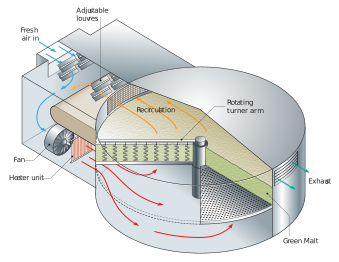
Figure: Single deck circular malt kiln