
Lesson 4 - Malting Process
This lesson deals with the malting process. We investigate each stage of the malting process in detail. We describe the required physical and biochemical changes involved in the conversion of barley to malt. We also discuss the vessels used for malting and explain how they help to produce malt of optimum quality.
Germination Technology
At the end of the steeping process, the chitted grain is transferred, wet or dry, to the germination vessel. Wet batches are typically pumped. Dry batches (water has been drained from the steep before transfer) are transferred to the germination vessel via conveyor belts.
In many malt plants, batches of malting barley are called pieces.
Traditional germination system
The oldest and most traditional method of using a controlled approach to germinate grain is to use a floor maltings. In this system, barley from the drained steep tank is spread out in a shallow 10-20 cm bed on a concrete floor. The barley is turned manually to prevent rootlets intertwining with neighbouring grains, called matting, and to remove heat. Temperature control and airflow is regulated by louvred windows in the maltings room that can be partially or fully opened or closed.
Modern germination systems
Modern germination vessels have these things in common:
- A stainless steel wedge-wire or perforated floor
- A means of turning the grain bed
- A pressure fan with an air humidification unit and recirculation ducts
- A means of blowing cool, moist air through the grain bed to:
- Prevent overheating
- Prevent the grain drying out too quickly
- Remove carbon dioxide
Today’s germination vessels (GVs) consist largely of two different types, namely germination boxes (Saladin boxes) and circular GVs.
Saladin boxes
Modern Saladin boxes can be over 50 m long and hold over 300 t barley. The figure below shows the features and design of a Saladin box,
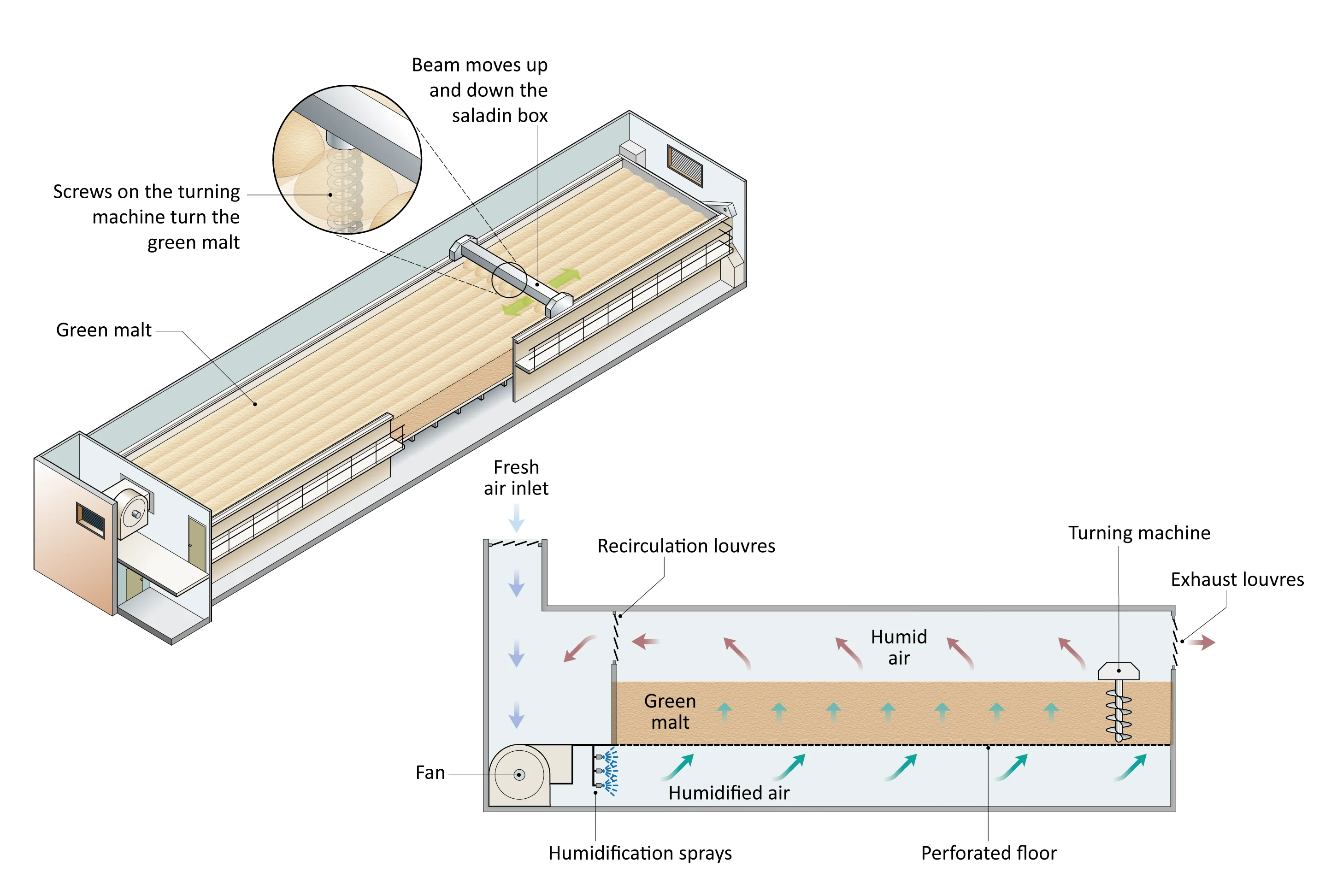
Figure: Saladin box
A beam moves along the length of the box and attached to the beam are helical screws. The figure below shows the design of these helical screws:
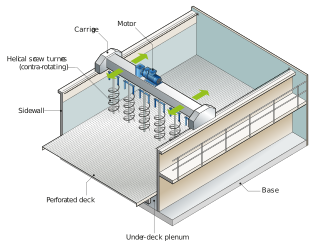
Figure: Helical screws in an empty Saladin box
Helical screws turn the bed. Each screw rotates in the opposite direction to its neighbour and as a result moves the grain from the bottom of the bed. As shown above, heat and CO2 are removed by forcing temperature controlled humidified air through the bed. Bed turning prevents matting and helps remove heat and CO2. The moisture level in the bed is maintained using water sprays attached to the beam.
Circular vessels
Circular vessels operate similarly to a Saladin box, but are circular.
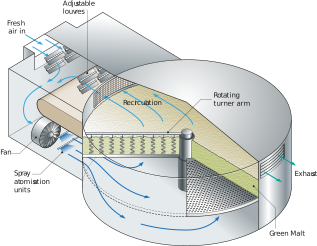
Figure: Circular germination vessel
Wanderhaufen system
In this system (meaning ‘moving piece’), the germinating malt is moved in steps along an extended 60 m box or ‘street’, twice daily over an eight-day cycle. Barley pieces are loaded from steeps on one end and finished pieces are discharged at the other end for transport to the kiln. Specialised turners or more modern inclined screw turners minimise mixing while moving the grain pieces along at 20-30 cm/min. Air flow is controlled separately over each of the 16 sections to accommodate the different stages at different parts of the street.