
Lesson 4 - Process Instrumentation
This lesson takes a closer look at process instrumentation. Whilst it explores the basic operations of manual instruments, it primarily focuses on the instruments that can be used in process control. It also investigates in more depth the instrumentation commonly used within the brewery.
Vessel Content Measurement
Vessel content normally refers to the volume, weight, or level of a substance in a vessel.
Level instruments come in the form of switches or continuous level or weight sensors. As there are so many different types of instrument, we will not go into the details of each and will instead cover those that most commonly used. Recently, many older types of instruments have experienced a resurgence as manufacturers have discovered novel ways to upgrade them to electronic options.
Manual instruments
Vessels with graduated sight glasses are still commonly used, but they are not very beneficial to process control. Floats with external displays can also be used.
Point level switches
Level switches are often used where continuous level is not important. These are normally used if you only need a few points on a vessel measured, such as empty (low level), filling point (intermediate level), or full (high level). These instruments have the advantage that they are not affected by calibration, although their sensitivity can be adjusted.
Level switches on fluids are often either tuning fork or capacitance level switches. Tuning forks work on the principle that tuning forks vibrate at a different frequency dependent on whether they are in air, a liquid, or a solid. This change in frequency is detected and used to activate the switch.
Capacitance level switches measure the capacitance between the probe and the vessel. This reading is then used to detect whether the probe is covered with liquid or not. We can install a long probe throughout the length of a vessel, which can give a continuous level measurement.
Level switches on dry materials can be in the form of paddle switches. The paddles are rotated and as soon as they are covered, the rotation is stopped, and this is then detected.
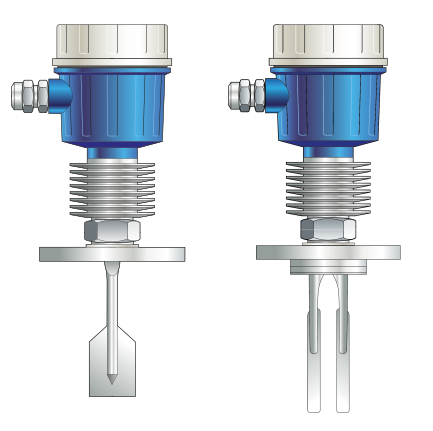
Figure: Examples of point level switches
Load cells
Load cells are typically used to measure the weight in a vessel. A strain gauge measures the force on each load cell. It is standard practice to use three load cells where possible, although we can also use four load cells for larger vessels. If you have ever been in a restaurant where your four-legged table has rocked back and forth, you will understand why three load cells are better than four!
For load cells to work correctly, the vessel should not be hard piped or flanged, and flexible hoses or bellows should be used. If high accuracy is not required, some installations will only use one load cell and then multiply it with the number of legs.
Pressure level instruments
As pressure is proportional to the height of a fluid and its density, pressure instruments can also be used to measure the level in a tank. If the tank is pressurised, we can use either two pressure instruments (one above the liquid level) or a differential pressure instrument.
Ultrasonic, radar and guided radar devices
These devices all work on a similar principle, where a beam is reflected off a surface and the return signal is measured. They all work on ‘time of flight’ principles. With guided radar, the radar beam is guided to go straight to the product via a probe. This means that the device is in contact with the media. Examples of these devices are shown below:
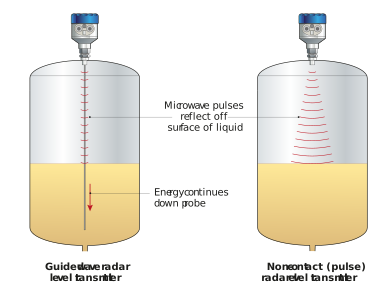
Figure: Ultrasonic, radar and guided radar level instruments
Foam considerations in level measurement
Whilst we want our freshly poured beer to have a good head of foam, foam in the process can wreak havoc for many forms of level measurement. This is why we must understand the principles that underpin each particular instrument. Ultrasonics are affected by foam, whilst radar and pressure devices are not. Capacitance and tuning forks are both affected. If you are only looking for a point level, then this is less of a problem as the sensitivity of devices can be adjusted. In some applications, you may use a point instrument to specifically measure foaming, so that you can take the appropriate measures to reduce this. Capacitance as a continuous level is affected by foam.