
Lesson 4 - Process Instrumentation
This lesson takes a closer look at process instrumentation. Whilst it explores the basic operations of manual instruments, it primarily focuses on the instruments that can be used in process control. It also investigates in more depth the instrumentation commonly used within the brewery.
Preface
Now that we have explored control systems and their various components, we are ready to take a detailed look at instrumentation.
Instrumentation has been around for thousands of years. Humans used instruments as an objective way to ascribe and agree on values of the things they measured. Sun dials are a good example of an early instrument used to measure time; some have been found to date from 1500 BC. The figure below shows a typical sundial:
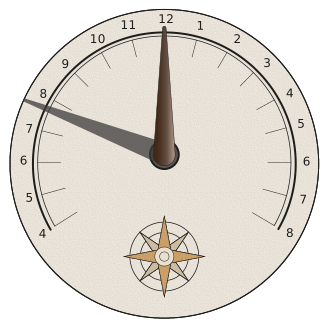
Figure: Typical sundial
Instruments cover a range of equipment that can detect a change in a measured variable and convert the information to an understandable form. These values can either be displayed or relayed in one form or another. Instruments consist of various parts, which can include sensors, displays, converters or transducers, processors, and transmitters.
So, what is a sensor? Just like humans have senses that take in information from the environment, the operators and the control systems need sensors to take in information from the environment. A sensor is thus anything that can measure a physical variable. This is then converted to a signal via a transducer or converter. If the measurement is more complex, a processor that forms part of the instrument may output a value, which is then transmitted to the control system.
If we relate this to a human, your eye is the sensor. It has a ‘transducer’ that converts it to a signal, which is then transferred to a processor in your brain via the optic nerve. From here, it is transferred to your onboard PLC to make sure that you do not walk into things!
A sensor is the part that physically measures a variable.
An instrument is the entire unit that outputs a measurement in a usable form.
Before we cover the various instruments in more detail, let us briefly explore the terminology that we use to describe important instrument parameters.