
Lesson 4 - Process Instrumentation
This lesson takes a closer look at process instrumentation. Whilst it explores the basic operations of manual instruments, it primarily focuses on the instruments that can be used in process control. It also investigates in more depth the instrumentation commonly used within the brewery.
Temperature Instruments
Temperature instruments are one of the most commonly used physical instruments. They play an extremely important role within the brewery and are a necessity.
Think about how many processes are controlled to a set temperature. Without a way of measuring and transmitting this, any form of automated control would be impossible.
The first thermometers were invented in the 1600s. Before this, temperature was a very subjective measure, and “too hot” or “too cold” was but a matter of opinion.
Temperature switches and gauges
A thermostat is the most basic form of temperature switch. If you have an electrical geyser (hot water tank with a heating element), the thermostat will control your geyser at the required temperature. Thermostats can be mechanical; in which case they use a bimetallic strip. The two different metals expand and contract at different rates, causing the strip to bend. By adjusting the contact surface, the circuit will be completed at the corresponding temperature, which then powers the element. The figure below illustrates a typical thermostat:
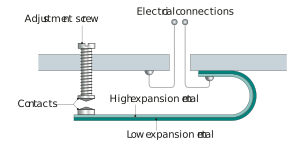
Figure: Bimetallic thermostat
The temperature gauges that are found in a brewery typically work on a bimetal principle. A bimetal coil inside the gauge will uncoil itself as the temperature increases, which causes the indicator on the gauge to move.
We have probably all been in office buildings that are too hot or too cold, then had the resulting arguments over the temperature setpoint. Apparently, it is common for installers to put in dummy controllers to give people the illusion of control.
Temperature sensors
An RTD (resistance temperature detector) is the most common form of temperature sensor. It works on the principle that a metal’s resistance increases with increased temperature. The resistance of a metal resistor inside the sensor changes as the temperature changes.
If you have heard about a Pt100, you are probably wondering what it stands for? It is a platinum RTD with a resistance of 100 Ω at 0°C.
Most temperature sensors found within a brewery will be RTDs. RTDs have the advantage that their output is fairly linear.
RTDs can come in two-, three-, and four-wire configurations. The RTD itself may be platinum, but the wires to and from the RTD are usually copper. Depending on the length of these wires, the resistance within them can change due to a change in the surrounding environment’s temperature. By adding another wire, we can measure the resistance in the wire, and subtract it from the resistance of the RTD. Three-wire systems are often used in the brewery. Four-wire systems run two extra wires so that one set supplies the power and another set is used for measurement. This gives an extremely accurate value, and this is normally only used for very sensitive laboratory applications. We must remember that instrument readings (not only for RTDs but other sensors too) can be influenced by the environment, and this should be taken into account.
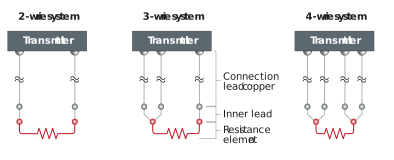
Figure: Two-, three-, and four-wire RTD systems
A thermistor is a special form of RTD that uses ceramics or polymers for the resistor. Its output is exponential, and it is mostly used within motors or other electronic devices to protect against overheating.
Thermocouples use two metal wires to output a voltage relative to the temperature in the gap between them. They are used mainly in higher temperature applications and are thus not normally found within a brewery.
As the price of electronics has reduced, it has become more common to install an electronic temperature transmitter with a local display.
Now that we have covered the ‘hot topic’ of temperature instruments, we can now move on to pressure.