
Lesson 4 - Process Instrumentation
This lesson takes a closer look at process instrumentation. Whilst it explores the basic operations of manual instruments, it primarily focuses on the instruments that can be used in process control. It also investigates in more depth the instrumentation commonly used within the brewery.
Pressure Instruments
Pressure is another important indication of what is happening within a process. Many applications in a brewery rely on the correct pressure in order to operate optimally.
We may want to remind ourselves of the difference between absolute pressure and gauge pressure. Absolute pressure is pressure measured against a vacuum and includes the effect of atmospheric pressure. Gauge pressure is the pressure measured against atmospheric pressure.
Manual pressure gauges and switches
The most common form of pressure gauge is known as a Bourdon gauge. It consists of a hollow spiral tube that is connected to the pressure being applied. The tube straightens as the pressure increases, which in turn moves the pointer via links and gears. This process is shown in the figure below:
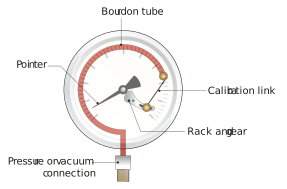
Figure: Operating principle of a Bourdon gauge
Diaphragm gauges are fitted with a diaphragm that separates the process fluid from the inner workings of the gauge. Diaphragms can operate at far lower pressures and can be designed for hygienic applications. Inside the diaphragm are a number of mechanisms, including Bourdon type tubes or other mechanisms. The figure below shows some of these examples:
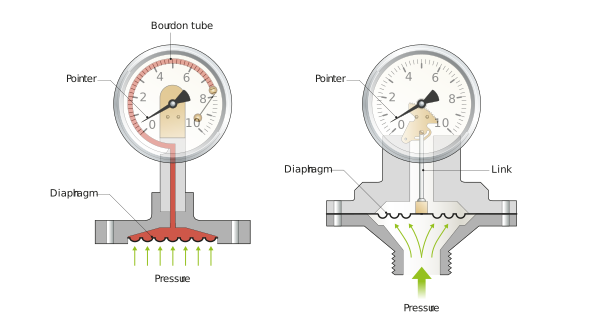
Figure: Operating principle of a diaphragm gauge
Differential pressure gauges work on similar principles, however the two different pressures are applied to the same gauge.
Pressure switches can also be linked to similar mechanisms.
Pressure sensors
Pressure sensors can operate on a variety of mechanisms. The most common type is based on a strain gauge linked to a Wheatstone bridge circuit. Wires on the diaphragm change length due to the deformation of the plate. This in turn changes the electrical resistance, which can then be measured via a Wheatstone bridge. The strain gauge acts as the sensor and the Wheatstone bridge acts as the transducer.
The figure below shows both a typical strain gauge diaphragm and the circuit for a wheatstone bridge:
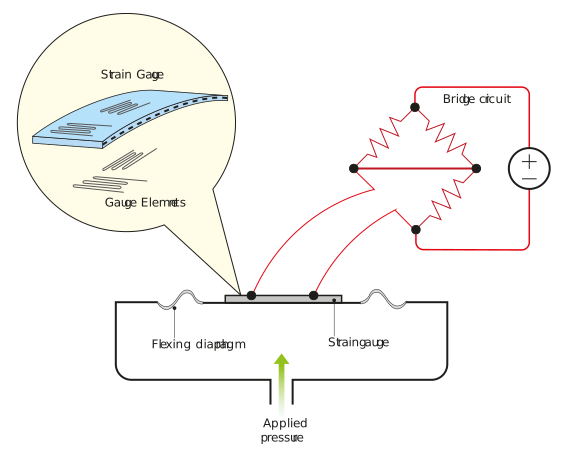
Figure: Mechanism of a strain gauge diaphragm pressure sensor
There are other mechanisms that we could use, which work on either capacitance or piezoelectric principles.
So now that we have covered pressure, let us “go with the flow….”