
Lesson 4 - Process Instrumentation
This lesson takes a closer look at process instrumentation. Whilst it explores the basic operations of manual instruments, it primarily focuses on the instruments that can be used in process control. It also investigates in more depth the instrumentation commonly used within the brewery.
Mass Flowmeters
A Coriolis is another type of flowmeter that is frequently used.
As you may be able to tell by the name, this flowmeter measures mass. It works on the Coriolis principle. By splitting the flow into tubes, the flow creates forces that twist the tubes. The deviations that result from this twist are measured. This reading is then used to compute the flowrate.
The following video illustrates they principles on which the Coriolis mass flowmeter works. Note, this is for illustrative purposes only and is not a recommendation or endorsement of the supplier’s product:
Do not be daunted by the details here. The important thing to understand is that the Coriolis mass flowmeter measures mass and density. This means that it can compute a volumetric flowrate. It is more expensive than a magflow, so it is normally only used where mass flow is important, such as in steam applications. However, because it measures density, it can be used to output the gravity of a wort stream. It is thus sometimes installed in wort lines.
A number of other types of flowmeters are also worth mentioning. The figure below compares some of these. It is important to remember that each type of flowmeter will come with its own range. So in every case, you must consider the details of each individual piece of equipment.
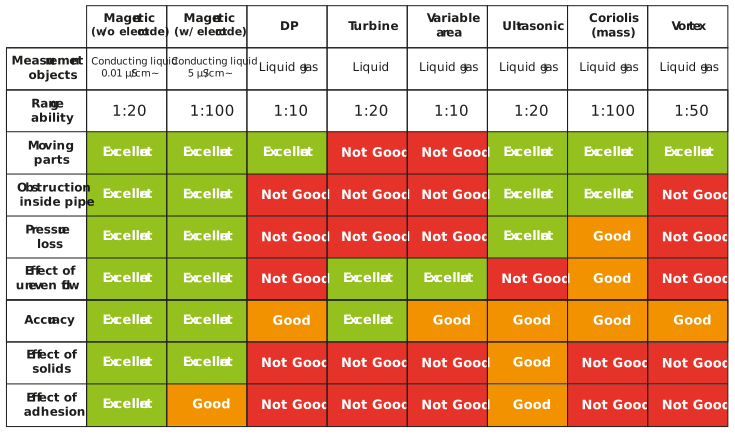
Figure: Comparison of different flowmeters
For a more detailed comparison of various flowmeters, the following resource is very useful. Note, this is for illustrative purposes only and is not a recommendation or endorsement of the supplier’s product:
https://www.engineeringtoolbox.com/flowmeter-selection-d_526.html