
Lesson 4 - Process Instrumentation
This lesson takes a closer look at process instrumentation. Whilst it explores the basic operations of manual instruments, it primarily focuses on the instruments that can be used in process control. It also investigates in more depth the instrumentation commonly used within the brewery.
Flowrate Instruments
Measuring flow is important. It allows us to control the flowrate of certain processes and also to know the total volume that has been transferred or run through a process.
Some flow instruments can only output instantaneous flowrates, whilst others only measure cumulative volumes. Most electronic flowmeters can now measure both output rates and totals.
Manual flowrate instruments
Manual flowrate instruments work on the principles of fluid dynamics. This is covered in more detail in the Fluid Mechanics unit. As a result, we will not delve into the associated equations within this lesson.
Common manual flowrate instruments that are used within the brewery include:
-
Differential pressure flowmeters – measure the difference in pressure as a result of a constriction using Bernoulli’s equation. The constriction can be in the form of an orifice or a vortex.
-
Turbine and paddle flowmeters – work on the principle of rotating a turbine inside a pipe.
-
Rotameters – work on the principle of a float within a tapered tube. As the flowrate increases, the increased pressure on the float makes it float higher in the tube (which is graduated).
The output of all of these instruments can be converted to electronic signals. Turbine flowmeters are often used for utilities and areas where hygiene is not an issue.
Electronic flow instruments
There are a number of electronic flow instruments. The most common instrument used within a brewery is an electromagnetic flowmeter, commonly referred to as a magflow or a magmeter. So how do these operate?
Magflows operate on the principle of Faraday’s law. A magnetic field is applied across the pipe. As the velocity increases, the positively and negatively charged ions in the fluid are split in an increasing way and this causes an induced voltage in the electrodes that are placed at right angles to the magnetic field. The figure below illustrates this:
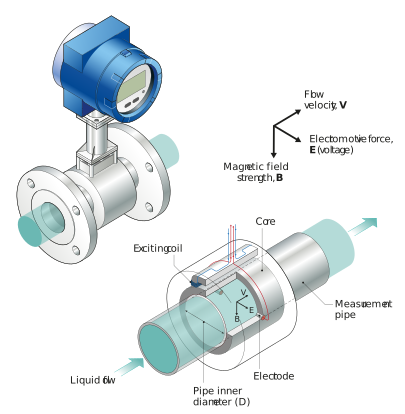
Figure: Working of an electromagnetic flowmeter
Magflow meters do not restrict flow. They are well-adapted to hygienic applications. They have good accuracy over a wide range. However, they require the fluid to be conductive and they do not work on gases. Some magflows even work with partially filled pipes.
Another form of flowmeter is an ultrasonic flowmeter. An ultrasonic wave is transmitted across a pipe. The signal moves faster when going with the flow, and slower when going against the flow. The speed is related to the velocity. Ultrasonic flowmeters can be used on large pipes and can even be strapped on externally. They are, however, heavily affected by bubbles in the liquid and need a long length of straight pipe before them in order to be accurate. The figure below shows a typical ultrasonic flowmeter:
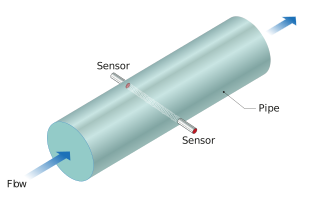
Figure: Working of an ultrasonic flowmeter
Vortex flowmeters work on the principle that if there is a column-shaped obstruction in a flowing fluid, it will generate alternating vortices downstream. The frequency of the vortices is proportional to the velocity. The vortices are normally detected using ultrasonics or a mechanical measurement device. The figure below illustrates how this works:
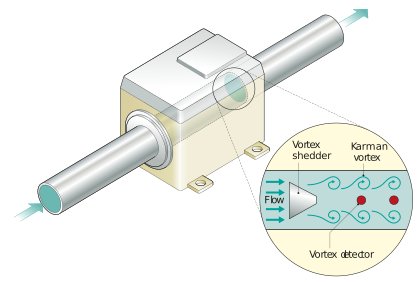
Figure: Working of a vortex flowmeter
Vortex flowmeters work very well in gases and liquids. They are mostly used for steam applications within the brewery. The principle can be combined with pressure and temperature measurements to give an accurate mass flow, which is useful when measuring the mass of steam.
The following video illustrates the workings of a magflow. Note, this is for illustrative purposes only and is not a recommendation or endorsement of the supplier’s product:
The following video illustrates the workings of an ultrasonic flowmeter. Note, this is for illustrative purposes only and is not a recommendation or endorsement of the supplier’s product:
The following video provides a good illustration of the workings of a vortex flowmeter. Note, this is for illustrative purposes only and is not a recommendation or endorsement of the supplier’s product: