
Lesson 4 - Wort and Beer Analysis
This lesson looks at how to analyse the composition of wort and beer. It covers the current methods for each analysis, outlining the basics of how they are undertaken. It then explains the methods and standards used to ensure that analysis is both precise and accurate. Finally, it discusses how laboratories collaborate so that proficiency levels can be determined.
Analyses Principally on Beer (CO2)
CO2 is a fundamental component of beer. It affects the aroma and flavour of beer and plays a crucial role in head formation and retention. The right level is therefore essential for happy consumers.
CO2 by thermal conductivity
A thermal conductivity detector measures the thermal conductivity of the gas flowing through it. The electrical resistance of the detector changes according to the thermal conductivity of the gas flowing across it, and this is measured to determine the concentration of the gas. The Corning 965 (later Mettler Toledo) analyses a sample of beer that is prepared by fixing the CO2 as sodium carbonate. The machine doses lactic acid into the sample, releasing the CO2 which is measured by the thermal conductivity detector. These machines are no longer manufactured but are still widely used.
In the Hach Orbisphere CO2 analyser, a thermal conductivity detector is combined with a gas diffusion membrane. The small volume enclosed between the diffusion membrane and the thermal conductivity detector is periodically flushed with nitrogen. After each purge, the sample CO2 diffuses from the sample through the membrane, changing the thermal conductivity of the gas surrounding the detector. The rate of change of the thermal conductivity is used to calculate the concentration of CO2. It is also possible to measure dissolved nitrogen with these units by changing the settings and changing the purge gas to CO2.
CO2 by pressure and temperature measurement
The simplest way to estimate CO2 in beer is by measuring the pressure and temperature of the beer in an enclosed container. Instruments which perform this measurement are sometimes called Gehaltemeters, With the manual version of this instrument you need to refer to tables for partial pressures of CO2 at particular temperatures while others undertake the calculation internally. The simplest versions require manual agitation of the beer while automatic ones undertake compression and depression of the beer in a sealed chamber within the machine.
Here is a video showing the more simple version being used:
Note, this is for illustrative purposes only and is not a recommendation or endorsement of a particular supplier’s product.
Unless other gases in the solution, like oxygen and nitrogen, are measured independently and factored into partial pressure calculations, using pressure and temperature measurements will always overestimate the concentration of CO2.
CO2 using attenuated total reflectance infrared (ATR-IR) spectroscopy
In ATR-IR spectroscopy, an IR beam is directed onto a sapphire crystal at a prescribed angle. Reflectance within the crystal generates an evanescent wave (the amplitude of the wave decreases with distance) which extends beyond the surface of the crystal into the beer that is in contact with the crystal.
The evanescent wave is attenuated by the CO2 in a region of the IR spectrum characteristic of the gas. The attenuated beam returns to the crystal, then exits the opposite end of the crystal and is directed to the detector in the IR spectrometer. The detector records the attenuated IR beam, with the degree of attenuation being proportional to the concentration of CO2. Because CO2 absorbs IR at a unique point in the spectrum, other elements of the beer will not interfere with the measurement of its concentration. ATR-IR is currently only used for in-line measurement of CO2.
A video explaining ATR-IR spectroscopy is at the bottom of this page: https://www.thermofisher.com/uk/en/home/industrial/spectroscopy-elemental-isotope-analysis/spectroscopy-elemental-isotope-analysis-learning-center/molecular-spectroscopy-information/ftir-information/ftir-sample-handling-techniques/ftir-sample-handling-techniques-attenuated-total-reflection-atr.html
Note, this is for illustrative purposes only and is not a recommendation or endorsement of a particular supplier’s product.
CO2 by multiple volume expansion (MVE)
The MVE method makes use of the lower solubility of air in beer compared to CO2. We fill a chamber with beer and then seal it. Then we expand the volume of the chamber, which causes gas to come out of solution. Once the pressure and temperature come to equilibrium, the pressure and temperature of the chamber are measured. We again expand the chamber and allow it to come to equilibrium, and the pressure and temperature are measured again. We use the measurements from both expansions to calculate the concentration of CO2, correcting for the influence of air, oxygen, and nitrogen. Because air is less soluble, its partial pressure decreases much more than that of CO2 when the chamber expands. The figure below shows this relationship.
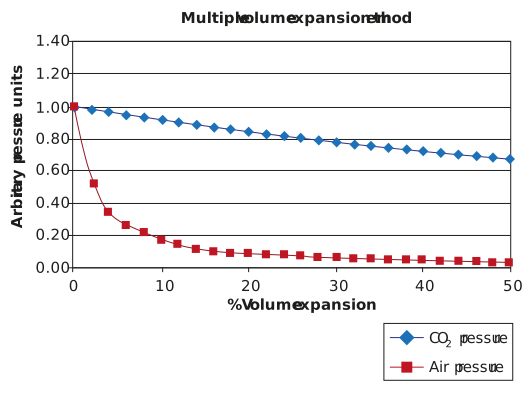
Figure: Equilibrium partial pressures at increasing volume
The video below shows how to use a piercing device and a machine that uses MVE to measure CO2. Note, this is for illustrative purposes only and is not a recommendation or endorsement of the supplier’s product.
https://www.youtube.com/watch?v=d3UPUUhreZA
CO2 by laser
It is possible to measure the CO2 level in products without opening the container. A laser beam of a specific wavelength is passed through the headspace of the container and the molecules of CO2 absorb the light. The amount of absorption is proportional to the partial pressure of CO2 and hence the level in its product. The link below provides more information.
https://foodandbeverage.pentair.com/en/products/haffmans-non-invasive-co2-measurement-selector