
Lesson 4 - Wort and Beer Analysis
This lesson looks at how to analyse the composition of wort and beer. It covers the current methods for each analysis, outlining the basics of how they are undertaken. It then explains the methods and standards used to ensure that analysis is both precise and accurate. Finally, it discusses how laboratories collaborate so that proficiency levels can be determined.
Analyses on Wort and Beer (SG and pH)
This section covers the basic procedures which are undertaken on wort and beer hundreds of times per day. It also covers the more advanced, complex tests which are undertaken a few times per year. We begin with tests for specific gravity.
SG by pycnometer
The pycnometer is a bottle which, when filled and dried externally, will contain a precise volume of liquid.
There is an explanation of how they are used here:
And this is what one looks like:
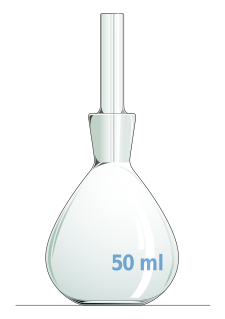
Figure: Pycnometer
We determine density by filling the pycnometer with a sample and weighing it. We then subtract the weight of the empty pycnometer to find the weight of the sample. Next, we fill the pycnometer with distilled or deionised water and weigh it again. Subtracting the weight of the empty pycnometer gives us the weight of water. To calculate SG, we divide the sample weight by the water weight. Weight is mass x acceleration by gravity, so a correction factor is used to account for that. Use of the pycnometer is the reference method for SG determination. However, the validity of the result is dependent on both good technique by the person using it and very accurate weighing scales.
We use SG measurement to monitor the progress of fermentation and to calculate both the amount of alcohol generated (discussed later in this lesson) and the remaining extract which influences the body and mouthfeel of the beer. The SG at the start of a fermentation (prior to yeast addition) is known as the original gravity and the SG at the end of the fermentation is known as the final gravity (FG). The measurement at any time during the fermentation is known as the present gravity (PG). These gravity measurements are used to calculate the performance of the fermentation, which will be discussed later in this lesson.
Many brewers work in Plato (°P). There are conversion tables available on the internet that will convert SG to °P.
SG by densitometer
Most lab analyses of SG are undertaken on a densitometer. These have quite a complex operating principle. At the heart of the machine is a U-shaped tube that is electronically excited to oscillate at its characteristic frequency. The U tube is depicted in the figure below.
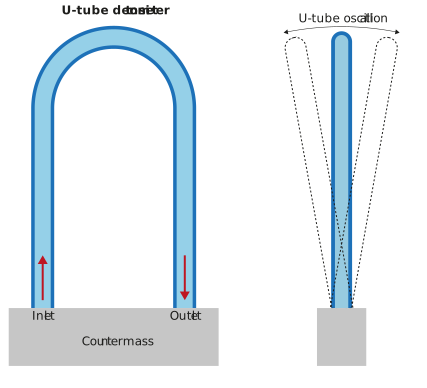
Figure: U tube of a densitometer
Optical pick-ups detect a light beam which is interrupted as the tube oscillates. In the same way as it is more difficult and so slower to wiggle a cannonball than a ping pong ball with your hand, a heavier U tube oscillates at a lower frequency. The frequency of oscillation is progressively reduced by an increasing density so measuring oscillation frequency enables the machine to calculate the SG. The viscosity of the sample also affects oscillation by acting as a damper. We need to factor this into the machine’s calculations by calibrating it with different samples of the products of interest.
The accuracy of a densitometer is reduced greatly if the machine is not cleaned effectively. Even a fine microfilm will have a significant impact on the results. Samples analysed by densitometer need to be degassed as any bubbles will make the result meaningless. Likewise, samples should be clarified by filtration or centrifugation to prevent suspended particles affecting the measurement.
The densitometer is usually the principle behind the many in-line gravity measurement devices available to brewers today.
Why do you think dirt in the tube or the presence of bubbles or suspended material will make your densitometer reading inaccurate? Give yourself 5-10 minutes to think about this, and then click ‘Next’ to continue with this lesson.