
Lesson 4 - Wort and Beer Analysis
This lesson looks at how to analyse the composition of wort and beer. It covers the current methods for each analysis, outlining the basics of how they are undertaken. It then explains the methods and standards used to ensure that analysis is both precise and accurate. Finally, it discusses how laboratories collaborate so that proficiency levels can be determined.
Analyses Principally on Beer (Vicinal Diketones)
Vicinal diketones (VDK) are important flavour compounds. They are welcome, to some extent, in beers where butterscotch is part of the required flavour profile but are an offensive off-note in others.
Analysis of VDK encompasses both the flavour active 2,3,butanedione (diacetyl) and 2,3,pentanedione and their precursors. For measurement of the precursors, the sample must be aerated and then incubated at 60 °C for 90 minutes to convert it into VDK before the process is started. We then saturate a sample of beer with ammonium sulphate in a sealed vial, and add 2,3,hexanedione as an internal standard. The VDK and other volatiles are allowed to enter the headspace of the vial. The contents of the headspace are then injected into the machine.
When running the sample through the GC, we also run standard samples of varying concentrations of 2,3,butanedione (diacetyl) and 2,3,pentanedione. These samples are prepared in the same way as the sample from our beer and are run through the GC before and after the sample. For VDK we use an electron capture detector (ECD), which measures the change in the resistance between the electrodes as the VDK molecules pass through.
We use peaks plotted on the graph from the GC, for the standard and our sample, to calculate the concentration in the beer. The presence of SO2 in beer can supress detection of diacetyl by GC by forming an addition compound. Headspace chromatography can also be used for esters and acetaldehyde.
A modern system using gas chromatograph ionic mobility spectrometry (GC-IMS) claims to produce reliable results for VDK concentration without any sample preparation in 20 minutes.
Details of GS-IMS are here: How does GC-IMS testing work? | Odournet
Note, this is for illustrative purposes only and is not a recommendation or endorsement of a particular supplier’s product.
Gas liquid chromatography (GLC)
GLC is slightly different to GC in that the stationary phase in the column is a layer of liquid on an inert solid matrix. The operation of the column is essentially the same as using a solid stationary phase, and the calculation of results is likewise based on curves drawn from data on external standards. The figure below shows the set-up of a GLC.
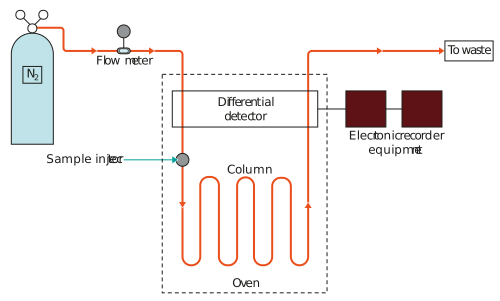
Figure: Gas liquid chromatograph set-up
We can use GLC for VDK and also for measuring sulphur-containing compounds, higher alcohols, and esters.
VDK by colourimetry
In the colourimetric test for VDK, the beer sample is centrifuged before being distilled for 8-10 minutes. We mix the distillate with o-phenylenediamine and the VDK forms 2,3-dimethylquinoxaline with the o-phenylenediamine. The sample is then acidified and we read the absorbance at 335 nm in a spectrophotometer.
A slightly more rapid version of this method is available from Hach who supply a tube to which you add the distillate. This reduces the test time to around 10 minutes.
An alternative method is to mix the distillate with α-naphthol in alkaline solution. This produces a red colour, the absorbance of which is measured at 530 nm. This method is known as the ASBC broad spectrum method because it does not discriminate between the vicinal diketones.