
Lesson 4 - Wort and Beer Analysis
This lesson looks at how to analyse the composition of wort and beer. It covers the current methods for each analysis, outlining the basics of how they are undertaken. It then explains the methods and standards used to ensure that analysis is both precise and accurate. Finally, it discusses how laboratories collaborate so that proficiency levels can be determined.
Point of Reflection – Reconvene
Welcome back. So, what were your thoughts?
The figure for your (OG – PG) is:
54 – 9.25 = 44.75
This puts the beer in the 36.1-46.5 category so your F factor will be 0.130.
To calculate your abv you multiply your OG – PG figure by the F factor, so:
44.75 x 0.130 = 5.82% abv
ABV by gas chromatography (GC) and flame ionisation detection (FID)
GC is used for measuring the majority of volatiles in beer. As with the other types of chromatography we have considered, GC separates components of a mixture by their affinity (called the adsorption coefficient) to the stationary phase in the chromatograph. The stationary phase in this case is the lining of the chromatography column. The mobile phase in a GC is an inert gas known as the carrier gas. If the component of interest has a low affinity for the stationary phase, it passes out of the column rapidly. If it has a high affinity, it takes a lot longer. A detector is used to recognise the components as they leave the column. Different detectors are used for different substances.
To use a GC for abv analysis we dilute with n-butanol as an internal standard. Internal standards are substances added at a known concentration which form the reference point for the calculation of the concentration of the compound(s) of interest. We then inject the sample into the GC, where it is vaporised. The vapour is then carried through the GC column. The gas leaving the column is mixed with hydrogen and air and it is ignited and passed across a flame ionisation detector. The detector measures the electrical current conducted by the ions and electrons in the flame from the ignited gas.
Solutions with a known concentration of ethanol are passed through the system to calibrate the detector. The readings from the detector, which appear as peaks on a graph, are processed by computer with reference to both the internal standard and the calibration solutions to provide the concentration in the sample. This is a very expensive and complex way to measure the abv of a sample, but it is very accurate.
A GC with FID is also used to measure levels of dimethyl sulphide and other low boiling point volatiles in beer. This is covered later in this lesson.
ABV by near infrared (NIR) spectroscopy
NIR spectroscopy uses the absorbance of infrared light by ethanol to calculate the abv. In the equipment the sample is held in front of a source of infrared. The infrared passes through the sample and is diffracted by a diffraction grating to disperse the light. A detector measures the intensity of the dispersed light which has passed through the sample. The hardware of the NIR spectrometer is shown in the figure below.
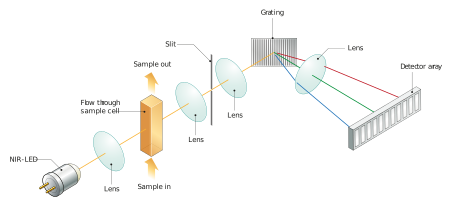
Figure: Inside the NIR spectrometer
The loss in intensity at 1,200 nm is related to the quantity of ethanol in the sample. We select 1,200 nm because light of this wavelength is absorbed to a greater extent by ethanol than it is by water.
The accuracy of the method is affected by other constituents of beer. Proteins and other large molecules will also absorb light at 1,200 nm so can be wrongly measured as alcohol. Multivariate calibrations for a range of samples are therefore required. NIR gives inaccurate results on beer which has not been filtered before measurement so even in-process samples need to be bright before injection into the machine. We also need to degas samples as bubbles will affect measurement.
In the Alcolyzer from Anton Paar, NIR is combined with a densitometer and the machine uses SG and abv to calculate OG and the apparent and real degree of attenuation. Most large breweries use this system.
The SCABA machine which measures ethanol by catalytic combustion is no longer manufactured and has largely been superseded by the Alcolyzer.