
Lesson 4 - Wort and Beer Analysis
This lesson looks at how to analyse the composition of wort and beer. It covers the current methods for each analysis, outlining the basics of how they are undertaken. It then explains the methods and standards used to ensure that analysis is both precise and accurate. Finally, it discusses how laboratories collaborate so that proficiency levels can be determined.
Point of Reflection – Reconvene
Welcome back. So, what were your thoughts?
The last section contained the analogy of it being harder to wiggle a cannonball with your hand than a ping pong ball. By leaving dirt in the U tube or particles in the sample you increase the mass in the U tube; this will make it oscillate slower and hence give you the wrong reading. In the case of dirt in the tube you are effectively adding the mass of the dirt to the density of the sample you inject. The opposite is true for gas bubbles. As gas is lighter than liquid every bubble in the solution will make the sample less dense and your reading will be too low.
SG by refractometer
When light passes through a clear liquid it is refracted (bent) to a certain extent. The greater the amount of dissolved substance, the greater the degree of refraction. In the refractometer, light enters the unit and passes through a pair of prisms. Between the prisms is a small amount of the sample. The angle of the light hitting the prisms is changed by twisting a cylinder on the refractometer until it is possible to see the boundary between light and dark. In essence, we have found the refracted light. In traditional refractometers this boundary is read against a scale which tells us the gravity. Manual handheld refractometers are the simplest form, are inexpensive, and are used by home brewers and small breweries across the globe.
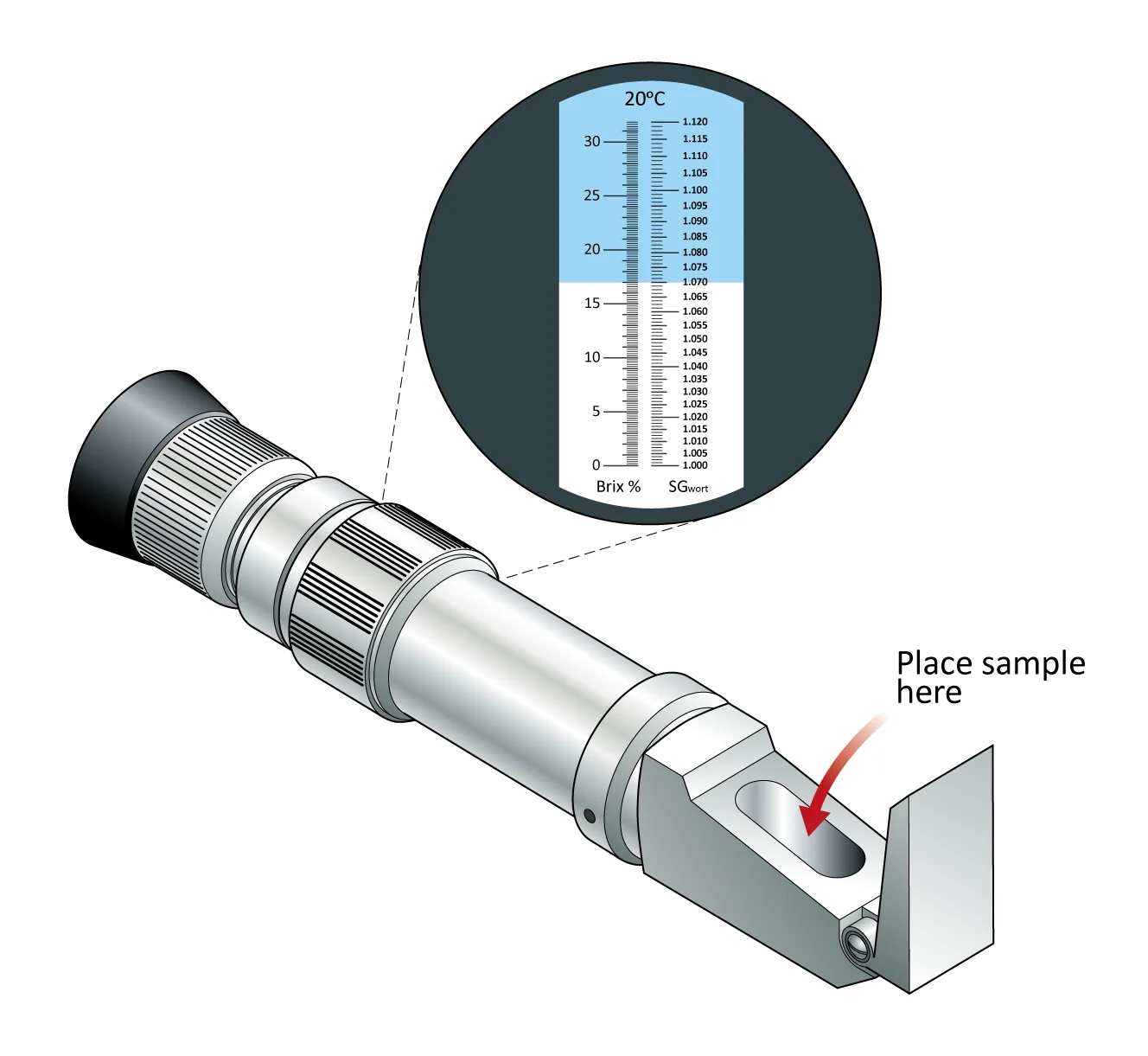
Figure: Handheld refractometer
In automatic refractometers, an LED produces the light, the intensity of the reflected light is controlled by a charge-coupled device (CCD) scanner, and the resulting position of the boundary between the light and dark is determined automatically. Automatic refractometers are much more accurate than the mechanical versions. The following figure shows the hardware set-up in a digital automatic refractometer.
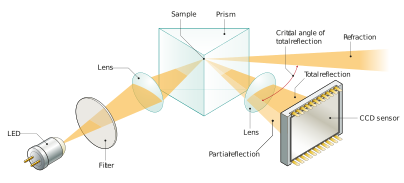
Figure: Hardware of an Automatic Refractometer
With manual refractometers the temperature of the sample must be at 20 °C. The refractive index as read from a manual refractometer will correspond to °Brix (which is very similar to °P) which requires a calculation or reference to a gravity table to convert into SG. Automatic machines make the conversion automatically.
SG by hydrometer
A hydrometer is a historic but very accurate instrument for measuring SG. Some large breweries still use a hydrometer to check if their expensive densitometer is working correctly.
The hydrometer is a weighted glass bulb with a stem that contains the scale. Some versions also have a thermometer inside to enable manual adjustment of the reading due to effects of temperature. The hydrometer floats further up in a column of liquid at increasing specific gravities. We must degas the beer so the bubbles in the solution do not affect the density or buoy up the hydrometer. For accurate readings the sample should also be clarified to remove yeast or trub as this can affect the measurement.
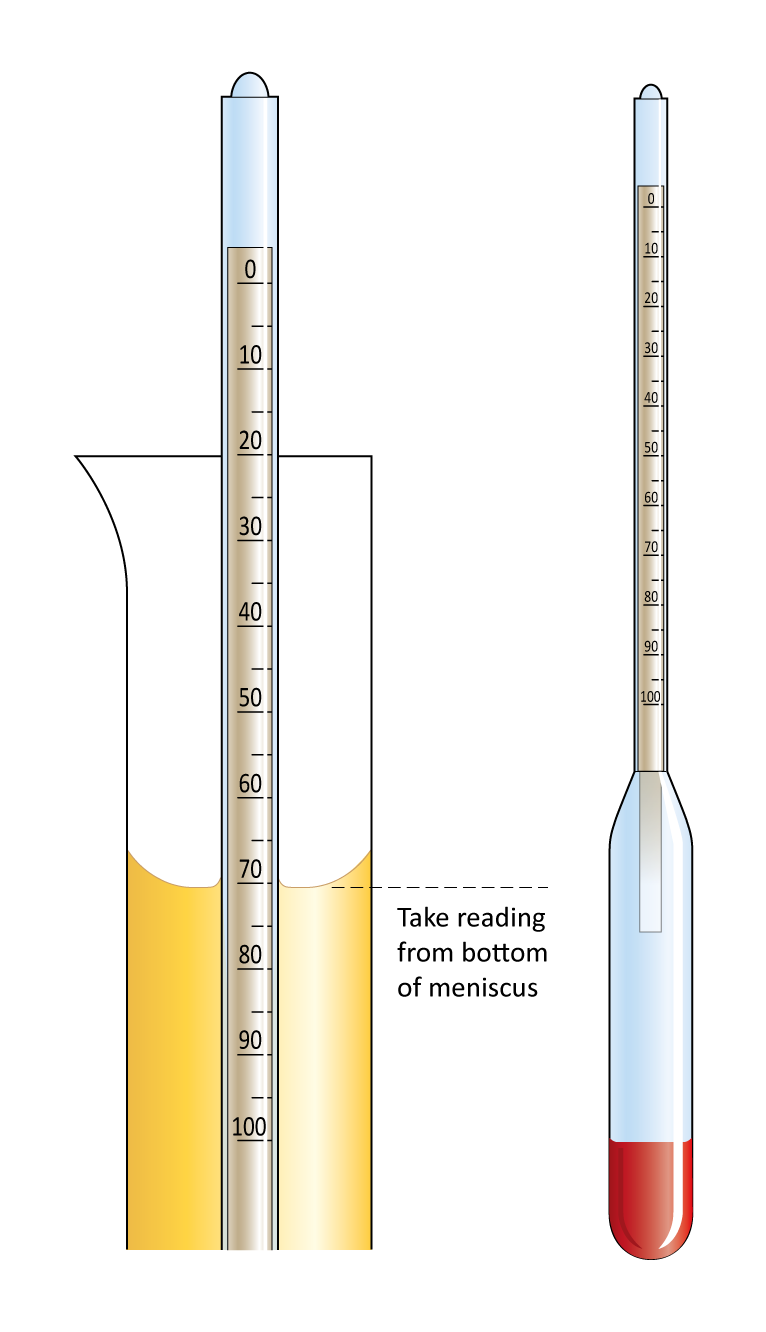
Figure: Hydrometer and jar
While temperature-correction tables can be used to correct for the effects of temperature, the most accurate method is to measure the beer at 20 °C.
Original gravity of beer can be either measured directly at wort collection or calculated from the measured abv and final gravity (see later).
pH measurement
pH can have wide-ranging effects in water, wort, and beer. That and the fact that it is a logarithmic scale means we need to be precise and accurate with our measurement.
We can read pH using litmus paper. This is paper impregnated with a pH sensitive dye. Colours resulting from dipping the paper in our sample can be checked against a scale to reveal the pH. Because the resolution is so low, these are only really suitable for validating CIP rinses.
We can also use a pH meter to measure the pH of our sample. This measures the potential difference between the sample and a buffer solution inside the electrode.
A more detailed explanation is given here:
Note, this is for illustrative purposes only and is not a recommendation or endorsement of a particular supplier’s product.
pH electrodes are delicate and we need to calibrate them before each use to ensure accuracy. The points of calibration should be in the main range of measurement undertaken. At least two points of calibration is essential for proper function. We also need to keep electrodes clean and they must be stored in an appropriate storage solution. Modern pH meters have automatic temperature compensation which will correct the reading to account for differences in sample temperature.