
Lesson 2 - Malt Intake, Handling, and Storage
This lesson details the principles and operations of malt intake, handling, and storage. It explains how and why malt is checked on delivery to the brewery. It also covers how it is taken in, processed, and stored, as well as how safety is maintained during malt handling.
The Weigher
Malt weighers are usually inline batch weighers, which can operate on a tip-scale or gravity drop method. The tip scale either mechanically or electro pneumatically tips to empty the scale of the designated amount. Contrastingly, the drop method simply opens a slide valve.
In batch weighing, we weigh portions of the grain and multiply the weight of the portion by the number of portions to calculate the total weight. Electronic batch weighers consist of a hopper on load cells with a valve on the inlet and outlet. The valve on the inlet opens and allows grain to fill the hopper. As it fills, the load cells measure the weight and when the target (batch) weight is reached the inlet valve closes and the weight is recorded. The outlet valve then opens and the grain leaves the hopper. When the hopper is empty, the outlet valve closes and the inlet valve opens to fill the hopper with another batch. The weight of each batch is multiplied by the number of batches weighed, to give the total weight of grain moved. A batch weigher is shown below.
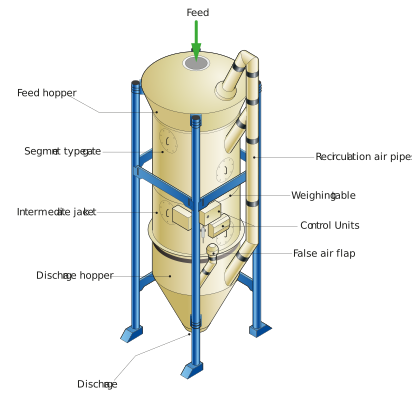
Figure: Batch weigher
The videos below show the operation of a batch weigher.
Please note this is for illustrative purposes only and is not a recommendation or endorsement of the supplier’s product.
In mechanical tip batch weighers, two hoppers are used and the grain flows in continuously. In these systems, a counterweight is used to hold the weigher over to one side, filling one of the hoppers. When the weight of the grain is greater than the counterweight, the hopper tips over. This releases the grain from the first hopper and allows grain to flow into the second. The same process occurs in the second hopper and then it is back to the first. The number of times the weigher tips is counted and used to calculate the total weight.