
Lesson 2 - Malt Intake, Handling, and Storage
This lesson details the principles and operations of malt intake, handling, and storage. It explains how and why malt is checked on delivery to the brewery. It also covers how it is taken in, processed, and stored, as well as how safety is maintained during malt handling.
Conveyors
Conveyors move malt horizontally or through inclines. They come in more forms than elevators. Let’s find out more, starting with screw conveyors.
Screw conveyor
A screw conveyor is also known as a worm conveyor or an auger conveyor. The diagram below shows its key components.
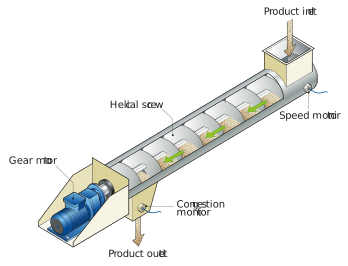
Figure: Screw conveyor
The screw conveyor is a cylindrical tube, or semi-cylindrical trough, housing a helical screw. An electrical motor rotates the screw and the screwing motion pushes the grains forward. Below is a summary of key points about screw conveyors.
-
Can be loaded or emptied at various points along its length
-
Can operate at maximum incline of 12°
-
Maximum capacity of 100 t/h
-
The clearance between screw and housing must be minimal to prevent grains slipping between the screw and housing and becoming damaged
-
Long movement distances are possible
-
Installation cost is low but energy use and maintenance costs are high
-
Outlets must be well designed so that grains can exit quickly or they will become blocked
-
Regular greasing of bearings is essential
-
They are not self-emptying, so access is required for cleaning
-
Can be fitted with CIP (cleaning in place) systems to aid cleaning
-
Can act as a barrier preventing dust explosions from spreading
-
Can be used to meter the weight of grain as it is carried through
-
Can be fitted with cooling jackets
Chain and flight conveyor
In a chain and flight conveyor, a chain is moved by a gear on a rotating motor along a track. The malt is moved by the flights which extend from the chain to each side of the conveyor housing. The diagram below shows a chain and flight conveyor with one side of the housing removed.
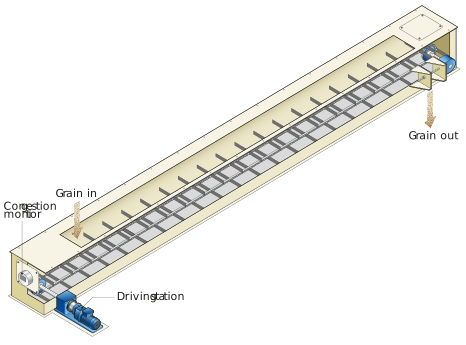
Figure: Chain and flight conveyor
Below is a summary of chain and flight conveyor key points.
-
Flights can be made from metal and plastic
-
Grain moves along as one bulk and there is little movement within the mass, resulting in less damage (as long as it is properly loaded)
-
Can be loaded or emptied at multiple points along its length
-
Can cause damage to more delicate grains
-
Maximum incline of 20°
-
Very high capacities are possible (up to 300 t/hr)
-
The speed of the conveyor is limited to 0.4 m/s
-
Long distances are possible
-
Low installation and running costs (energy and maintenance)
-
Maintenance of tracks is essential to prevent wear on sides/chain
-
Fully enclosed, so no dust is released to atmosphere
-
Dust explosion relief panels (which blow out in the event of an explosion) must be fitted on the housing
-
Jam switch required to stop the conveyor if the malt is backed up
-
Aspiration of housing is desirable
Pipe, chain, and disc conveyors
Pipe, chain, and disc conveyors, (also called tubular drag chain and disc chain and cable and disc conveyors) have low capacities and are used in small breweries or in large breweries for speciality malt and adjunct transportation.
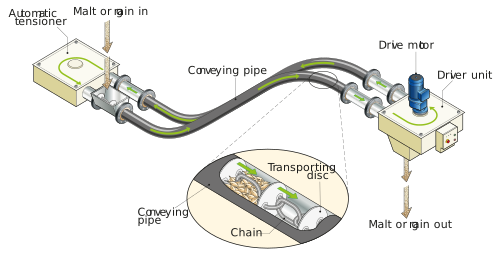
Figure: Pipe, chain and disc conveyor
Some key points about pipe, chain, and disc conveyors are:
-
Capable of speeds of around 0.5 m/s
-
Contains grain dust well
-
Gentle grain handling
-
Reasonably resistant to abrasion by grain
-
Capable of conveying malt vertically
-
Can be cleaned in place and fitted with cooling jackets
-
Can be loaded or unloaded at any point along the tubing
Pneumatic conveying
Pneumatic conveying is a bit different to the other types we have discussed. Instead of a mechanism, a fan either blows or sucks air along a duct and the grain is carried along with the air flowing through the conveying system.
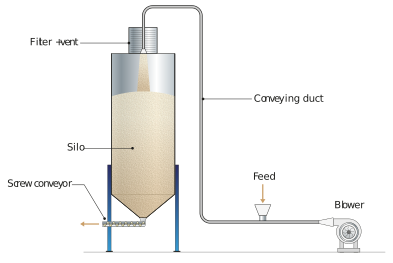
Figure: Outline of pneumatic conveying system
The two modes of pneumatic grain transport are compared in the table below.
Table: Comparison of vacuum and blow line systems
|
Vacuum System |
Blow Line |
|
Can collect from multiple points and deposit in one place |
Generally single feed with multiple deposit points possible |
|
Grain can flow freely into vacuum stream |
Grain must be fed in against air pressure so is forced in by rotary valve |
|
Cyclone and rotary valve used to remove grain from air flow |
Grain leaves the system easily, following the flow of air |
|
Any imperfections in pipework allow air in and this prevents grain/dust leakage |
Any imperfections in seals would mean product and dust will leak; therefore, regular maintenance is essential |
|
Relatively expensive to install and high running cost |
Relatively expensive to install and has high running costs |
Below is a summary of pneumatic conveying system key points:
-
Can follow very complex routes over long distances, which is an advantage in confined spaces or for fitting into existing buildings
-
Malt can be very abrasive so routes must be carefully designed, with gentle sweeping corners to prevent damage to the system
-
Can cause damage to grain as it collides with surfaces, especially in lean phase (high air to grain ratio) where speeds of 35 m/s are possible
-
Relatively expensive to install, with high energy use and maintenance costs