
Lesson 2 - Malt Intake, Handling, and Storage
This lesson details the principles and operations of malt intake, handling, and storage. It explains how and why malt is checked on delivery to the brewery. It also covers how it is taken in, processed, and stored, as well as how safety is maintained during malt handling.
Laboratory Testing
Larger breweries undertake testing of new batches of malt for quality and food safety parameters. The analyses are the same as those we discovered in the Malt Quality lesson, so we won’t cover their details again here.
As a reminder, the figure below provides a summary.
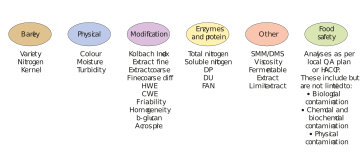
Figure: Malt analyses undertaken by some larger breweries
Malt is analysed by the brewery and the maltster according to the standard methods set out in the documents below.
-
Analytica EBC (European Brewing Convention) https://brewup.eu/ebc-analytica
-
Mitteleuropäische Brautechnische Analysenkommission (Central European Commission for Brewing Analysis) MEBAK collection https://www.mebak.org/en
-
American Society of Brewing Chemists (ASBC) Methods of Analysis http://methods.asbcnet.org/
Each analysis has a code number and the methods included within them are updated periodically, with obsolete methods archived. Labs can use these standards to reference an analysis and to ensure they are up to date. With both parties using the same procedure, the results should always largely agree.
If no problems with the delivery are identified, it can be taken in to malt storage. If there are any serious problems, the malt will need to be loaded back onto transport for return to the suppliers. Thankfully, in most breweries this is a very rare event. Returning malt is undesirable because it means we are spending time and effort without producing anything, and we may not have enough malt in stock to achieve the brewing programme.
The figure below summarises an example of a malt delivery acceptance process flow.
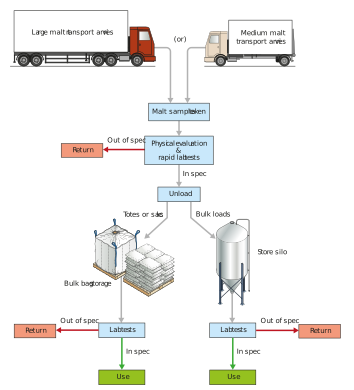
Figure: Malt delivery acceptance process flow diagram
Now that we have accepted the malt, it is time to process and store it. We cover this next.