
Lesson 2 - Malt Intake, Handling, and Storage
This lesson details the principles and operations of malt intake, handling, and storage. It explains how and why malt is checked on delivery to the brewery. It also covers how it is taken in, processed, and stored, as well as how safety is maintained during malt handling.
Rapid Analytical Methods
These analyses are relatively quick and simple to perform and are undertaken at the point of intake or in a satellite laboratory in the intake area.
The methods used are:
-
Near infrared NIR spectroscopy − NIR grain testers measure the effect of moisture and nitrogen (protein) levels on optical properties of grain in the near infrared portion of the electromagnetic spectrum. Moisture and protein absorb light in specific bands in the NIR spectrum. In the NIR meter, NIR light is shone on the malt sample and a detector measures the amount of light not absorbed by the sample. The greater the amount of protein or water present, the greater the absorption. NIR spectroscopy can also be used to measure carbohydrates and lipids. The figure below shows an NIR meter.
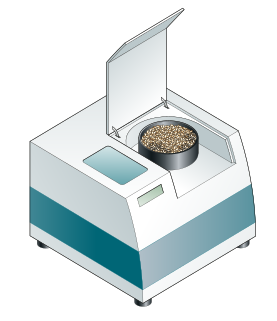
Figure: NIR meter
-
Dielectric (conductivity) moisture meter − this method measures the conductivity of the grain. Water conducts electricity better than a dry grain, so the grain’s conductivity measurement relates directly to the amount of water in the kernel. The grain is crushed between two plates, and a small electrical current passes through them. The use of conductivity for determining moisture content is unusual in breweries today, with most preferring NIR. The figure below shows a conductivity moisture analyser.
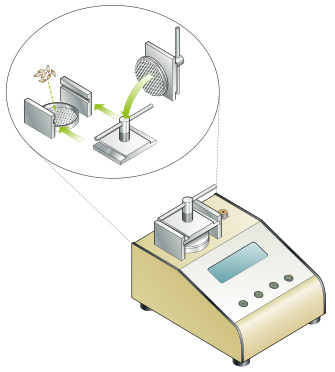
Figure: Conductivity moisture analyser
-
Bulk density measurement – some breweries measure the weight of a known volume or known number of malt grains. Equipment that weighs and counts a known volume of grains is available.
The video below shows how to use a meter that measures bulk density (hL weight) and moisture using conductivity.
Please note, this is for illustrative purposes only and is not a recommendation or endorsement of the supplier’s product.
-
Plansifter − grain sizes in a sample can be measured using a plansifter. A plansifter is a stack of containers with screens of decreasing hole size (larger holes on the higher containers, with smaller holes on the lower containers). To process a sample, a pre-weighed amount of grain is poured into the top screen, and a timer is started. The plansifter shakes the sieves back and forth for a set period – typically one minute. Once the timer ends, the grain held back by each screen is weighed and recorded. The brewery will typically set a limit on the proportion of the sample that is smaller than 2.2 mm in diameter. Plansifters are also used to measure the effectiveness of milling, as we will find out later in the unit. The figure below shows a plansifter with a container in the magnified bubble.
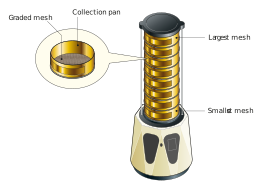
Figure: Plansifter
If any of the results from rapid analysis are out of specification, the load might be resampled for lab analysis or just sent back to the suppliers.
All the above are quick analyses and will be undertaken before the malt is unloaded. Most breweries do not have the luxury of transport that will wait while the malt undergoes full lab analysis, so if the grain looks good so far, it is usually unloaded to a holding silo while awaiting confirmation that it is acceptable from the lab.