
Lesson 2 - Malt Intake, Handling, and Storage
This lesson details the principles and operations of malt intake, handling, and storage. It explains how and why malt is checked on delivery to the brewery. It also covers how it is taken in, processed, and stored, as well as how safety is maintained during malt handling.
Silo Contents Determination
How do we tell how much grain we have in our silo? There are a number of ways to establish this; we can discuss them now.
The oldest method is to measure the height of the top of the grain in the silo from the floor by dropping a plumb line into the silo. This height is then used to calculate the volume of grain in the silo. The volume of the grain in the silo is calculated from the volume of the base cone, the volume of the cylindrical section, and the volume of the cone of grain on the surface of the malt (using the angle of repose). The bulk density (measured on the sample at intake or on a sample taken from an inline sampler during silo filling) of the grain can then be used to convert the volume into the mass. Malted barley has a bulk density of around 0.5 t/m³.
Another option is to use radar (radio detection and ranging) level detection. Here, a transmitter sends out a radio signal and a detector measures the reflected radio waves. This method measures how far the surface of the malt is from the detector and hence the volume of grain in the silo. A processor will use this figure to calculate the mass of grain based on a figure established during commissioning. The figure can be adjusted according to the bulk density of the malt.
The figure below shows some options for silo level measurement.
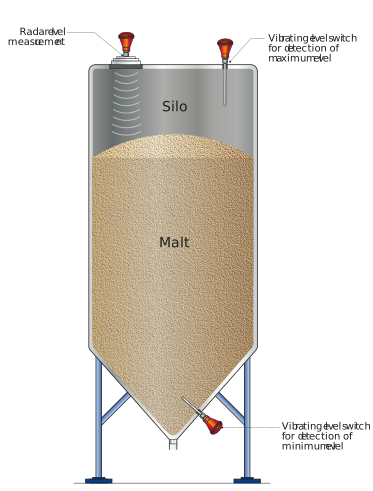
Figure: Silo level management equipment
Also shown on the figure are vibrating level switches that indicate when the silo is empty and full. Sensors that work on the basis of resistance to rotation are also used. The automatic systems in modern breweries that operate the malt handling system use signals from each of the sensors to regulate the filling and emptying of silos. Historically, electronic measurement systems were relatively inaccurate due to the presence of dust. However, modern versions achieve good levels of accuracy. That said, any system estimating mass based on volume and bulk density is only as accurate as the bulk density measurement on a sample of the malt.
The most accurate method of silo contents measurement is to have the silo installed on load cells that measure the mass of the silo based on the pressure exerted on each cell. This is shown in the figure below.
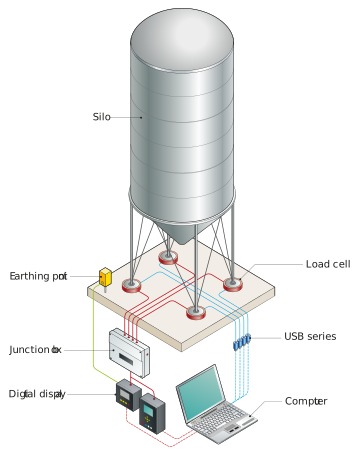
Figure: Silo on load cells
This is an expensive option and is not really suited to outdoor silo installations where the prevailing wind can greatly affect the mass reported by the system. The conveyors filling and emptying the silos cannot be bolted directly to the silo, as they will affect the weight recorded. They also require a lot of maintenance and calibration validation.
Another option that is not frequently used is to use an inline malt weigher to measure the mass of malt added to the silo.
Stock control
Most modern breweries have computer-based stock systems as a part of their enterprise resource planning (ERP) package. Smaller breweries may use paper records. Whatever system is used for tracking stock, the level reported on the stock system needs to be verified by a visual check of stock. The silo therefore needs a safe means of visually checking the silo contents. The accuracy of all automatic systems for estimating silo contents must be regularly validated.
Malt stocks should always be managed on a first in first out (FIFO) basis and stocks should always be kept to the minimum required to complete the short-term brewing programme. The shorter the period that the malt is stored at the brewery, the lower the risk to the malt.