
Lesson 2 - Malt Intake, Handling, and Storage
This lesson details the principles and operations of malt intake, handling, and storage. It explains how and why malt is checked on delivery to the brewery. It also covers how it is taken in, processed, and stored, as well as how safety is maintained during malt handling.
Malt Storage Conditions
If malt is not stored in the correct conditions, the quality of the grain as confirmed at intake will not be maintained and the performance of the malt in the brewery will be diminished.
During malt storage we need to ensure that we control:
-
Moisture
-
Temperature
-
Mould
-
Pests
During kilning, the malt supplier has gone to great lengths to ensure the moisture level is correct for safe storage and milling. Throughout storage, we need to monitor and maintain these levels. Another factor which affects the spoilage of the grain is temperature.
The best temperature for grain in storage is below 15°C. Below this temperature, insects and mites are inactive, and the growth of fungi is limited.
To lower the grain temperature in grain storage, we can draw cold air through silos during the coldest nights of the year. The figure below shows a silo with a fan designed for this purpose.
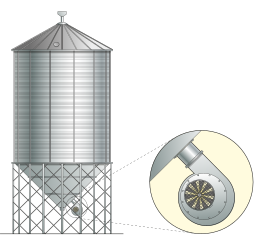
Figure: Silo fan for cooling and maintaining moisture levels
In warmer climates, it is impossible to maintain such a low temperature and keeping your grain cooler than the air temperature can lead to condensation forming and hence moisture levels in the grain rising!
Moisture and heat work together to cause grain spoilage and reduce enzyme levels in the malt. Higher moistures also reduce the effectiveness of milling.
Insects can cause damage to the grain by burrowing (boring) into them, chewing at kernels, or excreting unpleasant smelling materials onto them. Mould − Aspergillus species in particular − can contaminate the grain, producing dangerous mycotoxins and unpleasant flavours and odours. The activity of insects and growth of fungus can also raise the temperature in the grain, which accelerates spoilage. This heating can affect enzymes in the grain.
During its time in storage, temperature probes which extend into the mass of grain can monitor the temperature of the grain. There must be a sufficient number of probes to measure temperature throughout the silo. The silos can be fitted with sample ports at various points which allow samples to be withdrawn. As with intake samples, these should be taken from several ports and grain depths, then combined to provide a sample representative of the whole silo.
Although this all paints quite a bleak picture of malt storage, in most countries many of these problems do not materialise. Also, most breweries manage malt stocks so that malt is used within days rather than weeks, so it doesn’t get time to deteriorate. However, in some parts of the world, pests can be a serious problem and it is necessary to fumigate the grain in the silo. We will find out about this next.