
Lesson 2 - Malt Intake, Handling, and Storage
This lesson details the principles and operations of malt intake, handling, and storage. It explains how and why malt is checked on delivery to the brewery. It also covers how it is taken in, processed, and stored, as well as how safety is maintained during malt handling.
Malt Storage Silos
Malt spends longer in silos than any other part of the brewery. Their design is therefore important to protect it from harm. Let’s find out more.
Silo design and construction
Storage silos are usually made of galvanised steel and are formed from thin-walled sheets that are strengthened by corrugations and supported by external rings and stiffeners. The figure below shows this type of silo.
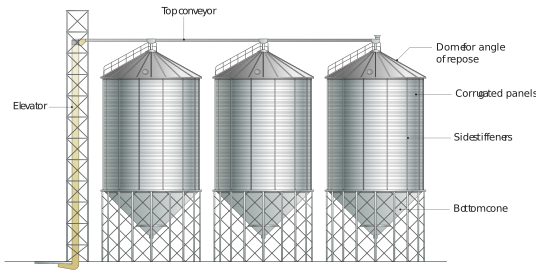
Figure: Galvanised steel silos
Smaller plastic silos are becoming more common for smaller breweries and for speciality malt storage in larger breweries.
Some older, larger breweries have concrete silo blocks. Grain can be stored in the silos and the spaces between. These spaces are called the interstices and are shown in the figure below.
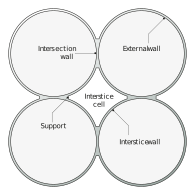
Figure: Silo interstices
Malt silos must be watertight and sealed to prevent the ingress of pests.
Silos have conical roofs to accommodate the malt that has formed into a peak as it was added. The height of this peak is determined by the angle of repose; for malt, this is typically around 30°. The angle of repose is the internal angle between the surface of the pile and the horizontal surface. The density, the surface area, the shapes of the grains, and the coefficient of their friction determine this angle. Material with a low angle of repose forms flatter piles than material with a high angle of repose. This all sounds a bit complicated, but it’s simpler if we think of what would happen if you tried to pile up golf balls (low angle of repose) versus mobile phones (high angle of repose). The figure below shows the angle of repose.
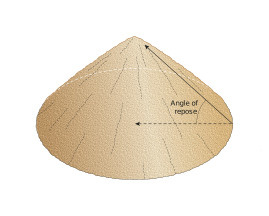
Figure: Angle of repose for grain storage
The angle of the base cone of a silo is also important. If the cone is too shallow, the silo will empty from the middle, with the malt at the side remaining stationary. This is called funnel flow. In extreme cases, funnel flow results in ratholing, which is where the grain at the sides stays put and there is a hole from the top to the outlet. The correct cone angle will reduce the risk of funnel flow and allow mass flow to occur.
The cone angle for malt silos required to achieve mass flow is around 60°.
The figure below shows mass and funnel flow and the link provides some information about silo design and management.
Please note, this is for illustrative purposes only and is not a recommendation or endorsement of the supplier’s product.
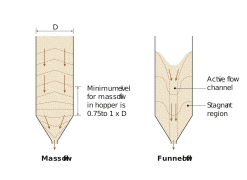
Figure: Silo discharge flow characteristics
As well as having the appropriate angle, the base cone of silos should be smooth and as slippery as possible to help the malt slide out smoothly. Any resistance to slip will impede flow. Some silo cones are coated inside with a slippery polymer to improve the slip.
Another silo-related problem is bridging, which is where the grain will stop flowing and form a bridge over the outlet supporting the bulk of the malt in the silo. Higher proportions of dust, and in some cases areas of higher moisture, can lead to bridging.
Although it is not considered best practice, some breweries overcome intermittent bridging by hitting the cone of the silo with a rubber hammer.
To avoid bridging and ratholing in silos, stock should be managed to ensure the silo is regularly emptied completely and is not continually topped up with new malt. This is also essential for traceability.